



Vestas announces three orders totalling 119 MW
- Details
- Category: Projects and Contracts
Vestas has announced three orders totalling 119 MW in the Netherlands, Belgium and Poland. All three orders include 20-year service agreements. In the Netherlands, Windpark Agro-Wind Reusel has ordered nine V163-4.5 MW turbines, with a combined capacity of 41 MW, for the Agro Wind Reusel project. Delivery is planned to begin in Q2 2027, with commissioning scheduled to start in Q4 2027.
Enerpac introduces new hydraulic pumps and tool storage system
- Details
- Category: Product News
Enerpac has introduced several products for wind turbine construction and maintenance, including the ZU4T Connect Torque Pump with integrated data logging, the lightweight LU-Series Electric Torque Pump and the Armor Stack storage system.
Dehn introduces digital platform for wind turbine lightning monitoring
- Details
- Category: Product News
Dehn has introduced Dehnsphere, a digital platform for monitoring and analysing lightning events on wind turbines. The platform uses data from the Dehndetect lightning current measurement system, which records lightning events directly on the turbine.
Radar system monitors bats around wind turbines in real time
- Details
- Category: Product News
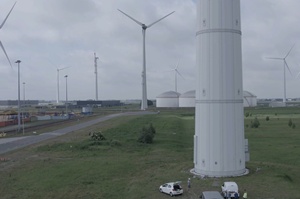 TNO, Dopplium and RWE are testing a radar-based monitoring system at Eemshaven in the Netherlands that tracks bats in real time. The technology could enable targeted turbine shutdowns when bats are at risk, rather than relying on broad precautionary shutdowns. The installation is part of the Turbine Bat Trace project, which started on 1 January 2026 with support from the Netherlands Enterprise Agency (RVO) through the EKOO Electricity 2025 programme. The system uses BatGuardian, a radar-based bat detection technology developed by Dopplium.
Korean Register and partners develop LNG carrier with WindWings
- Details
- Category: Product News
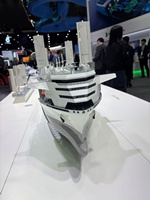 Korean Register (KR) has signed a Memorandum of Understanding (MoU) with HD Hyundai Heavy Industries (HD HHI), UK-based wind propulsion technology company BAR Technologies and the Liberian International Ship & Corporate Registry (LISCR) to jointly develop a 174K LNG carrier equipped with the WindWings wind-assisted propulsion system.
ABO Energy agrees to sell Argentine renewable energy portfolio
- Details
- Category: Projects and Contracts
ABO Energy has agreed to sell its Argentine portfolio to the Novva Group. The portfolio comprises renewable energy projects in development with a combined capacity of 3.17 GW. The transaction is expected to be finalised through a share purchase agreement following a confirmatory due diligence process in the coming months.
The WindEurope Board has elected Ørsted CEO Rasmus Errboe as its new Chair
- Details
- Category: Industry News
 The WindEurope Board has elected Ørsted CEO Rasmus Errboe as its new Chair and Enel Green Power CEO Salvatore Bernabei as Vice-Chair. Their 18-month terms begin today.
Nordex receives 91 MW order in Brandenburg
- Details
- Category: Projects and Contracts
Nordex has received an order from Teut Energieprojekte for 13 N163/6.X wind turbines with a combined capacity of 91 MW in Brandenburg, Germany. The contract also includes a 20-year service agreement. The Schönermark-Passow wind farm is being built near Schwedt/Oder in the Uckermark district.
Deutsche WindGuard adds AI assistant to asset management system
- Details
- Category: Product News
Deutsche WindGuard Systems has added wonBOT, an artificial intelligence-powered digital assistant, to its WONDER asset management system. Users can ask questions in natural language within the platform to retrieve operational information about their renewable energy portfolios.
GE Vernova to supply turbines for 29.4 MW Japanese wind farm
- Details
- Category: Projects and Contracts
GE Vernova’s Onshore Wind business has signed an agreement with Eurus Energy Holdings to supply seven 4.2 MW-117m wind turbines for the 29.4 MW Eurus Hiyamizutouge Wind Farm in Mutsu City and Higashidori Village, Aomori Prefecture, Japan. The agreement includes a two-year service contract, with an option to extend it for a further two years.
- Econergy acquires 740 MW French wind platform
- Powercon Group appoints Ravindra Chauhan to business development role
- Morecambe offshore windfarm receives consent for transmission assets
- ASCO opens Teesside office
- Albatross Technology and Sumitomo Heavy Industries form partnership on floating offshore wind
- Taiwan plans floating offshore wind demonstration projects
- VOS secures long-term ERRV contract for East Anglia wind farms
- EIB provides financing for Princess Elisabeth Energy Island
- Štip wind farm reaches financial close in North Macedonia
- Huisman introduces 1,200mt heavy lift pedestal crane
- Nordex to supply 34 MW for repowering project in Hesse
- Gennaker offshore wind farm reaches financial close
- Wind generation in the USA forecast to grow through 2027
- Hexicon secures additional financing
- Ørsted receives final opinion regarding taxation of Walney Extension and Hornsea 1
- DRI refinances 60 MW wind project in Romania
- Offshore excursion brings wind sector together
- Natural Power appoints new commercial director
- FoundOcean launches remedial solution for cable protection systems
- LIGHTWIND project prepares for second test campaign
- Suzlon secures 200 MW wind order from Ayana Renewable Power
- Feasibility study for Morocco’s first offshore wind farm
- Vattenfall takes final investment decision on battery project in Germany
- TGP opens office in Bilbao
- DWT awarded Riffgat offshore wind service contract
- The European Commision greenlights the Netherlands' fourth payment request under Recovery and Resilience Facility
- X1 Wind closes fourth funding round
- German Offshore Wind Energy Association elects new board
- Maine selects 800 MW wind project and transmission proposal
- Max Bögl and Vestas complete wind project with 199-metre hub height