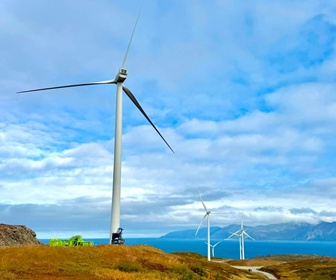




Wind turbine blades and tower made out of wood. Sounds great, both natural and recyclable. However, not so fast. It must be seen. At this time there are a few companies that work on this matter, and the first turbine with wooden blades has been in place [1] since 2024 in Germany. The19.3-metre (63-foot) long blades [2] are made from laminated veneer lumber (LVL). Also, a Vestas V90-2.0 (2MW) wind turbine with a 105 metre wooden tower [3] was inaugurated in Sweden in March 2024, and it can be presumed that it is still working. This is the tallest wooden tubular tower so far. A third company, Hasslacher Green Tower from Germany [4], manufactures timber hybrid towers. These towers are not enclosed and are more like truss towers. They are referred to as hybrid (wood-metal composite) since the timbers are joined together by metal fasteners. The company’s aim is to make towers for a hub height of around 137 metre that last for 25 years.
By Ahmad Hemami, McGill University, Montreal, Canada
It is evident that wood as a natural product, in line with nature, is a preferable choice to manufactured materials that involve pollution and environmental harm. Nonetheless, there are several other factors/conditions to be brought into consideration. These are primarily strength, size limitation, total weight, cost and transportation. Then, there are other concerns such as the likelihood of a turbine catching fire compared to current composite-material based blades and steel towers, the impact on trees and forests, and the reality about technology progress on recyclable blades.
According to Woodin CEO [1] “—at this pace (of industry growth) —we will end up with 50 million tonnes of blade material waste by 2050.” Definitely, this is not good if all this is buried, as it has been mostly done so far.
If we investigate the above factors one by one for both blades and towers, starting from the required strength for a blade under harsh forces and stresses, the immediate question is “can a blade withstand these stresses for 25 - 30 years?”. Imagine a wooden piece subject to all weather conditions (rain, snow, sunshine, temperature changes and the like) even without the stresses. The answer then can be “Maybe up to a certain blade length and up to x years, less than 25”. Nobody knows yet, and it has to be seen. It is appreciable that turbine manufacturers are open to the idea and give their support for a lengthy study.
For the blades used experimentally in the Vestas turbine, undoubtedly it is true that “We have conducted hundreds of laboratory tests during the past two years to perfect the blade material. According to all our tests, our blades are even more durable than the existing fibreglass blades, as they show fewer fatigue characteristics and are proven to endure all kinds of onshore weather conditions extremely well,” according to Voodin Blade Technology [2].
As for the weight, again it could be that up to a certain length a wooden blade can be a good candidate from the point of view of stiffness-to-weight ratio, but after that it is difficult to compete, since as the length increases the thickness of the material must accordingly be increased.
From the point of view of transportation, anyhow the blade length is a problem, no matter what the material is, but weight also comes as a secondary factor for transportation. Can a blade be modular? It looks less likely, as it is not easy from an equipment and site conditions perspective to put the pieces together on site. As well, the intersection(s) always will be the weak points.
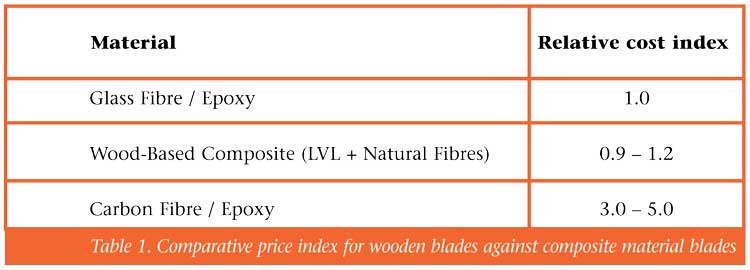
The cost is another issue, though probably less important than the functional factors. The reason is that the cost of a product is sometimes artificial and can vary according to geographic location (for raw materials), oil price (!) and labour.
The following table is for the relative cost comparison of the materials used in manufacturing of turbine blades, according to [5], which also, based on their modelling, predicts that wood-based concepts could economically serve 10–25% of the onshore blade market by 2030 in suitable regions, especially where local timber industries and recycling regulations favour bio-based materials.
Turbines do not catch fire often, but from time to time it happens. There are two issues on this matter. One is whether, in regions with frequent lightning, turbines with wooden blades are more prone to catching fire. The second issue is if the cause of fire is component overheating and oil leaks (probably these two, together, can lead to fire). On the first issue, if the answer is yes, then definitely wooden blades should not be used in that region at all. On the second issue, the conclusion is the reverse. If a turbine catches on fire, the contamination (smoke and debris) is better to be from wood rather than from composite materials.
As for the tower: In addition to all those factors considered for a blade, we need to remember that replacing truss towers with enclosed tubular towers were due to a number of reasons such as protecting the equipment including the cables and control panel from wind, rain, snow, sunshine and intruders. Thus, a timber-based truss tower may not be a good idea.
Further reading
[1] https://interestingengineering.com/energy/worlds-first-wooden-turbine-blades
[2] Woodin Blade Technology: https://voodin-blades.com
[3] Modvion: https://modvion.com/
[4] HASSLACHER Green Tower GmbH: https://www.hasslacher-greentower.com/en/tower-concept/
[5] Energy Solutions Intelligence: https://energy-solutions.co/articles/sub/wood-based-composites-wind-blades-biodegradable-turbine-concepts