





- Details
- Category: Publishers Note
 Global wind energy growth continues with strong expansion led by China
According to preliminary figures from the World Wind Energy Association’s Annual Report 2025, global wind capacity additions exceeded 169GW in 2025, marking a 35% increase compared with 2024. Total installed capacity rose to nearly 1,347GW, representing the strongest annual growth since 2020. Wind power generation approached 3,000 terawatt-hours and supplied more than 11% of global electricity demand.
- Details
- Category: Publishers Note
Coalition of the willing for renewables
The world is once again facing an uncertain future as multiple conflicts continue to unfold. In my March/April 2022 note, titled ‘How many wake-up calls does the world need?’, I reflected on the energy crisis at the time. As events stand today, it appears that more wake-up calls are needed, as the world finds itself in a similar situation. Oil and gas prices are rising sharply and it remains unclear when, or whether, they will return to more stable levels.
- Details
- Category: Publishers Note
North Sea offshore wind pact and US rulings highlight diverging policy paths
At the North Sea Summit in Hamburg, Germany, in January 2026, European governments, transmission system operators, and the offshore wind industry agreed an Investment Pact aimed at strengthening planning certainty, mobilising capital, and improving coordination in offshore wind deployment across the North Sea. Participating countries confirmed a long-term target of 300GW of offshore wind capacity by 2050 and outlined a coordinated buildout pathway supported by regulatory and financial measures.
- Details
- Category: Publishers Note
 Year in review: resilience amid policy shifts and market realignment
The past year has been defined by a widening policy divide between the USA and Europe, China’s continued dominance in wind manufacturing and deployment, and a renewed test of industry resilience in the face of regulatory uncertainty. What began with speculation about shifts in US federal energy policy has now materialised into a steady stream of restrictive measures, affecting both offshore and onshore wind development. At the same time, Europe has strengthened its long-term climate framework, while China has accelerated wind and solar deployment at a pace unmatched elsewhere.
- Details
- Category: Publishers Note
Daily legislative hurdles for renewable energy in the USA
Almost every day, new rules or policy changes emerge in the USA that place further barriers in the way of renewable energy projects. Wind and solar have been singled out most often, creating an environment in which developers face not just uncertainty but a series of obstacles that appear designed to slow deployment. By the time this note is published, it is likely that further announcements will already have been added to the list.
- Details
- Category: Publishers Note
Policy divergence deepens between USA and Europe in wind energy development
At the 2025 Cleanpower show in Phoenix, Arizona, USA the mood was cautiously optimistic following the announcement that the Empire Wind 1 project could resume construction. The U.S. Department of the Interior had issued a stop-work order just weeks earlier, raising fears that further delays might follow. However, despite this reprieve, the industry remains unsettled by the broader policy direction under the Trump Administration.
- Details
- Category: Publishers Note
Another bust and boom cycle ahead in the USA?
During almost three months in office, the new administration in the USA has taken several actions regarding wind energy. Initially, it instituted a six-month halt on new offshore wind leasing across the Outer Continental Shelf and paused new permits for both onshore and offshore wind projects. At the time, it was stated that existing leases would remain in place but would be subject to review for potential changes or cancellations.
Stay informed with Windtech International! Sign up here for our free newsletters

| Turbine Shots
brought to you by
 |
|
 |
|
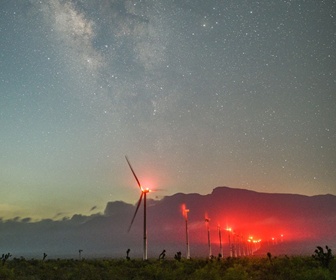
| #25 GE Vernova wind turbines installed at El Mezquite wind farm near Monterrey, Mexico (courtesy Alberto Salinas) | |
| Every week on our website and in our email newsletter we want to show you that wind energy is more than just technology. We therefore invite you to send stunning pictures of wind turbines inspired by “light” (in the broadest sense of the word). After 52 submissions we will announce the winner of the year’s best picture! Email your photo to Include turbine model, location and name of photographer. (size of the published photo will be 336 px width x 280 px high). |
|
|
|
 Check our Instagram to see all published pictures Check our Instagram to see all published pictures |