



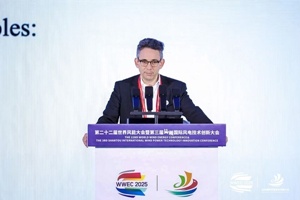
 The Shantou Declaration, adopted at WWEC2025, sets out principles for strengthening international cooperation in the wind sector. Ten years after the Paris Agreement, deployment of renewable energy has increased, with wind power playing a major role. Much of this progress, however, remains concentrated in a limited number of countries, highlighting the need to broaden the use of wind technology and support growth in more regions.
Developments over the past two decades have made Europe, China, India and the USA principal producers of wind technology, while many other countries continue to depend on imported turbines and equipment.
Meeting international goals will require increased manufacturing capacity and capability worldwide. This depends on resilient international supply chains, as well as the expansion of local manufacturing so that communities can benefit through employment and value creation.
Participants of WWEC2025 agree on the following principles:
- Wind power must expand in all regions, offering opportunities for the global wind sector.
- Manufacturing capacity needs to increase worldwide.
- Costs can still be reduced, supported by a degree of international work-sharing.
- International supply chains should be resilient and free from political disruption.
- Local benefits support acceptance and growth; high levels of local value creation are therefore important.
- Wind turbines require complex logistics and have substantial transport costs.
- International supply chains should operate under fair and transparent conditions.
- Export subsidies and import duties hinder supply chains and should be avoided.
- The global wind community commits to fairness, transparency, compliance with international trade and sustainability standards, and to the principles of the WWEA Community Engagement Guidelines.
- Ongoing dialogue within the sector and with policymakers is essential. A permanent Global Wind Power Cooperation Dialogue will be established to support this work.