



Kazakhstan, long recognised for its mineral and fossil fuel wealth, is increasingly turning to renewable energy as part of its green transition. The country has ratified the Paris Agreement and committed to reducing carbon dioxide and other harmful gas emissions by 15% by 2030, a target that could rise to 25% with support from international financial institutions. President Tokayev has set a long-term goal of carbon neutrality by 2060.
By Arman Kashinbekov, CEO, Association of Renewable Energy, Kazakhstan
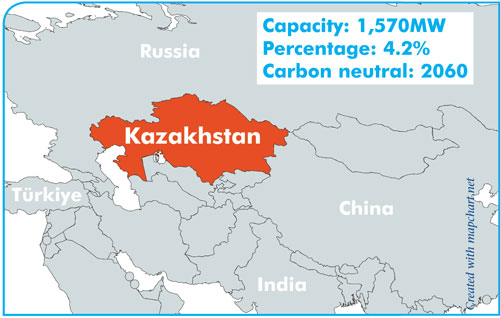
As of early 2026, clean energy accounts for approximately 7% of Kazakhstan’s total power generation. Onshore wind power contributes approximately 4.2% (1,570MW), with the remainder largely from hydro and other renewable sources. Coal-fired thermal stations continue to dominate the energy mix, supplying around 75% of electricity and heat, while natural gas and other hydrocarbons provide the remaining share. The country’s vast landscapes offer untapped potential for wind, solar, hydro and other sustainable resources, making it one of the largest renewable energy frontiers in the world.
From Early Hydropower to Modern Wind Projects
Wind and solar development began to accelerate after 2009, when Kazakhstan introduced its first renewable energy support law. Since then, the market has evolved from fixed tariffs for individual producers to auctions for larger projects. The country’s energy history stretches back much further – the Zyryanovskaya hydroelectric station, built in 1892, marked the first significant energy installation, with its 135th anniversary due to be celebrated in 2027. Today, falling capital expenditure on renewable projects is helping to lower tariffs for end consumers, with the aim of balancing the interests of producers and users.
Key Players and Growth Prospects
Kazakhstan’s wind energy market is shaped by both state and international actors. Samruk Energy, the largest state-owned energy company, dominates alongside Universal Energy in partnership with local firms. International investors are also entering the market, with Masdar, ChinaPower / State Power Investment Corporation and others preparing 1GW wind projects across the country.
Great potential lies in both onshore and offshore projects. The Caspian Sea, in particular, remains largely untapped, offering significant wind resources. The government is also prioritising the localisation of manufacturing, encouraging joint ventures and technology transfer to support domestic industry. Without local participation, large-scale projects risk generating limited value for Kazakhstan’s economy, a challenge that authorities are actively seeking to address by adopting international best practices.
Barriers and Ongoing Challenges
Despite rapid growth, barriers remain. The high cost of battery energy storage systems limits the ability to integrate intermittent wind and solar power reliably into the national grid. As renewable capacity expands, managing grid stability becomes increasingly complex. Kazakhstan must also navigate global market developments while remaining attractive to foreign direct investment, balancing short-term pressures with long-term strategic planning.
Investment Climate and Opportunities
Kazakhstan’s renewable energy market is described as modern and open, offering flexible investment options for both domestic and foreign stakeholders. Strategic investors can negotiate intergovernmental agreements for projects up to 1GW, while smaller annual tenders provide opportunities for several hundred megawatts of capacity. The Association of Renewable Energy of Kazakhstan is supporting initiatives such as rooftop solar and small wind installations, aiming for a total of 1GW of new capacity over the next decade. National legislation is regularly updated to streamline investment processes and facilitate efficient project delivery.
Long-Term Ambitions
While Kazakhstan is unlikely to achieve a fully renewable energy system in the near term, strategic documents reflect long-term ambitions for a low-carbon future. The country’s abundant oil, gas, uranium, gold and other mineral resources will continue to play a role in energy supply during the transition. However, authorities emphasise the importance of protecting Kazakhstan’s ecosystems and ensuring sustainable energy access for future generations. With its position as a regional energy leader in Central Asia, Kazakhstan is set to maintain a pivotal role in both conventional and renewable energy development for decades to come.
Windtech Markets is a collaboration between Windtech International and the World Wind Energy Association and is based on the WWEA Podcast.
map created with mapchart.net