



- Details
- Category: Articles
Using Probabilistic Remaining Useful Life Models to Optimise Wind Turbines
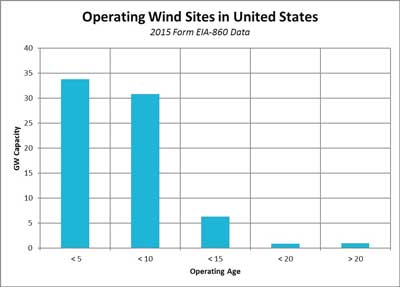 Wind turbine asset management is complex, but essential to maximise profits and maintain life cycle costs. The complexity arises for several reasons, including rapid technology development, complex supply chains and constrained infrastructure, remote locations and, more generally, lack of detailed failure data. The goal of asset management is to effectively manage corporate assets to gain maximum value, profitability and returns while safeguarding personnel, the community and the environment. A true asset integrity management programme incorporates design, maintenance, inspection, process, operations and management concepts, since all these disciplines affect the integrity of infrastructure and equipment.
By Nikhil Kumar, David L. Rogers and Philip Besuner, USA
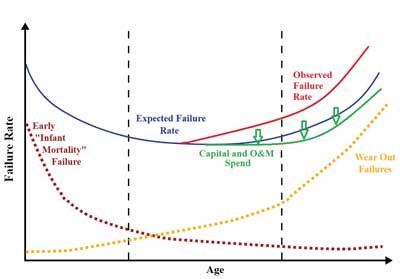 As worldwide wind energy capacity grows, with global installed capacity exceeding 450GW in 2016, ensuring reliable operation of these wind turbine generators (WTGs) becomes very important for owners and operators. The authors have executed several projects to review operational and commissioning challenges of onshore wind farms. In a number of cases, reliability issues early and late in the operational life of the equipment can be traced back to missteps during the commissioning or design phase. In this article, the authors will highlight their experience from a recent root cause investigation of equipment failures, discuss a probabilistic approach to estimating remaining life of WTG components and show actual data that supports these estimates.
- Details
- Category: Articles
A Pilot Plant for the Production of Renewable Hydrogen
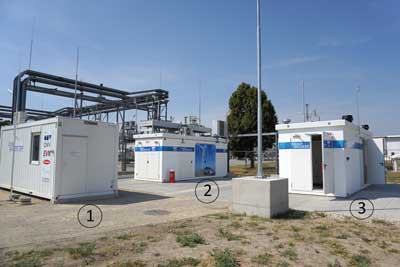 The pilot plant built within the course of the wind2hydrogen (w2h) research project is the first of this size in Austria and is unique of its kind. The main differences from other projects lie in the chosen type, design and control of the electrolyser as well as the possibility to provide multiple markets with renewable hydrogen. Current and future business cases are simulated in experimental operation from the perspective of the public power grid and the gas grid operator. With this comprehensive approach, reliable statements on the boundary conditions of the power-to-gas technology and future requirements for economic feasibility are expected.
By Andreas Zauner and Robert Tichler, Energieinstitut an der Johannes Kepler Universität, Austria
The aim of the w2h project is to develop the complete value chain from fluctuating wind power via electrolysis to injection into and storage in the gas grid as well as delivery to consumers of hydrogen in industry and transport.
- Details
- Category: Articles
Development, Validation and Certification of Ingeteam’s Power Converter in Suzlon’s S11x Wind Turbine
During the last 20 years, wind power’s share in electricity generation has substantially grown, making the power quality and stability of wind systems increasingly important. Consequently, the grid codes (which establish the requirements that all generation systems must fulfil in order to be allowed to connect to the grid) have been updated in order to guarantee the stability of the grid. Until the recent past, wind turbines were allowed to disconnect from the grid when transient changes in grid voltage might jeopardise the integrity of their elements, especially the power converter. However, nowadays, this is no longer allowed. Moreover, the turbines must also support the grid with active and reactive current during these transient conditions.
By Aritz Lorea, Product Manager, Wind Business, Ingeteam Power Technology, Spain
- Details
- Category: Articles
Mobile Wind Energy with Tethered Wings for Off-Grid Applications
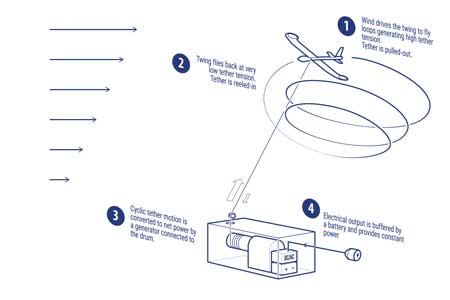 TwingTec is currently working on new wind energy technology that has the potential to unlock so far unused wind energy resources. The concept relies on a tethered wing which flies like a kite to harness the energy of wind. This enables access to winds at higher altitudes, which are typically stronger and more constant. No tower or foundation is needed, leading to an order of magnitude mass reduction compared to conventional wind turbines. The system can be containerised allowing for easy deployment. A first prototype has been built and tested. A product concept for a 100kW mobile wind energy system has been developed which addresses the needs of the off-grid market. Long-term systems in the megawatt range could contribute significantly to the global energy market.
By Dr Rolf Luchsinger, Co-founder & CEO, TwingTec AG, Switzerland
Wind turbines have become very successful over recent decades. According to the Global Wind Energy Council more than 63GW of new wind power capacity was installed in 2015 with an annual growth rate of 22%. Nevertheless, only a small fraction of the global energy supply is produced from the wind. In order to meet the renewable energy targets set by various nations significant efforts are needed. One way to accelerate the energy transition is to introduce new technologies. Such technologies have the potential to unlock so far unused resources.
- Details
- Category: Articles
TYER Wind’s Wind Converter
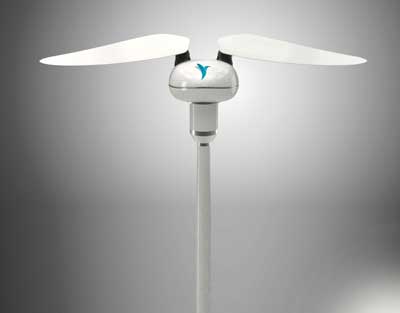 The TYER Wind vertical axis wind converter harnesses wind power using flapping wings that perfectly mimic the motion of one of the most energy-efficient birds: the hummingbird. Invented by Anis Aouini, the technology is a radical solution inspired by nature and turns out to be efficient, eco-friendly and perfectly scalable. No rotating blades; just flapping wings that convert wind power into green electricity thanks to their revolutionary 3D Aouinian kinematics.
By Anis Aouini, Inventor, Co-founder & Chairman of TYER Wind, Tunisia
Inspired from one of the most energy-efficient birds – the hummingbird – TYER Wind could take wind power in a whole new direction.
- Details
- Category: Articles
Turbine Foundations as an Opportunity for Marine Biodiversity
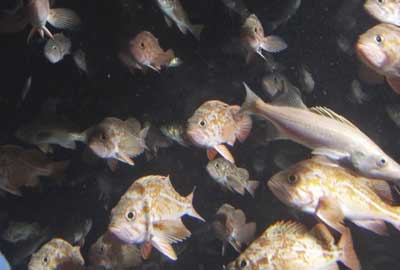 In view of the negative effects wind farms may have on the environment, especially during construction, the reef and reserve effects of turbine foundations (or their capacity to host diverse marine species) are often put forward as a sign of a project’s positive long-term footprint. Taking a closer look at the underlying ecological processes, there is more than meets the eye, and the potential ecological benefits of offshore wind farms go far beyond what could simply be considered as a few fish swimming around a monopile.
By Martin Perrot and Matthieu Lapinski, Seaboost, France
Extensive scientific studies carried out on offshore oil and gas infrastructures indicate that the extent of ecological benefits of offshore wind farms on marine ecosystems could be significantly improved by gaining a clearer understanding of their ecological functionalities. It is time to consider the opportunities brought by offshore wind farms for the development of marine biodiversity. It is time to build with nature.
- Details
- Category: Articles
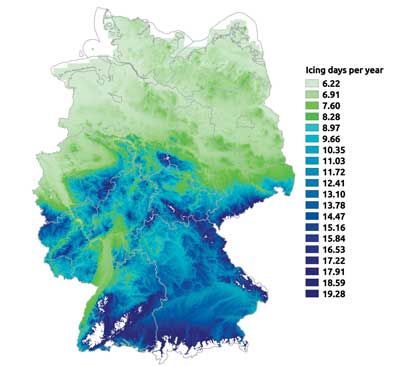 Experiences and Recent Developments in Germany
Ice throw from wind turbines is a serious environmental hazard. Experience in Germany may serve as a contribution to future standardisation of ice throw from wind turbines. No national or international standards exist, but they are urgently needed. The aim of this article is to give an overview of the critical points which should be assessed in a future guideline.
By Thomas Hahm and Nicole Stoffels, F2E Fluid & Energy Engineering, Germany
Wind energy in regions with icing conditions requires special attention regarding material and yield losses due to icing of the wind turbine. Several publications considering this topic exist, and also address the topic of hazards from ice throw, but only a few solutions are proposed. One recommendation is a minimum distance of the wind turbine of 1.5 times the hub height plus rotor diameter to objects in regions with severe icing conditions.