



- Details
- Category: Articles
 Security and Protection Using Sensor Systems
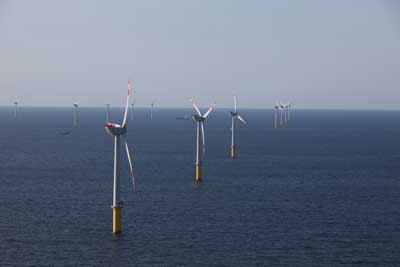
Sensor systems for offshore wind farms are used for the monitoring of many environmental and operational parameters. They monitor the internal turbine and loads condition, and also the environment of offshore wind farms. Wind speeds, wave heights and swell, as well as parameters related to the turbine condition such as oil temperature or pressure or rotor speed, are measured by sensor systems. However, sensors are also vital for safety and security. Each offshore wind farm element must be equipped with a fire detection system, which is based on sensor information. Access restrictions to sensitive areas (e.g. the monitoring room or nacelle) are also managed by sensors, and sensor systems guarantee the safe condition and positioning of rotor and nacelle (yaw system). The research project OWiSS, which is described below, focuses in particular on the safety and security issues.
By Julia Klatt, Deutsche Offshore Consult, Germany
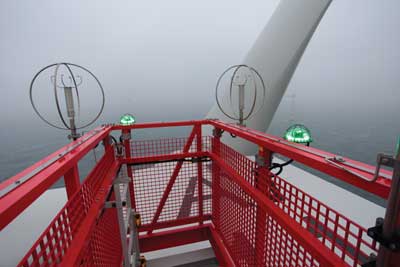 Offshore wind is becoming more important. Therefore, Deutsche Offshore Consult GmbH (DOC) decided to support the Offshore Wind Energy – Protection and Security (OWiSS) project, which aims to avoid and minimise threats for offshore wind farms with special focus on sensor systems in regard to the improvement of safety and security.
- Details
- Category: Articles
 Developments in Mooring Installation Technology for Floating Offshore Wind Structures
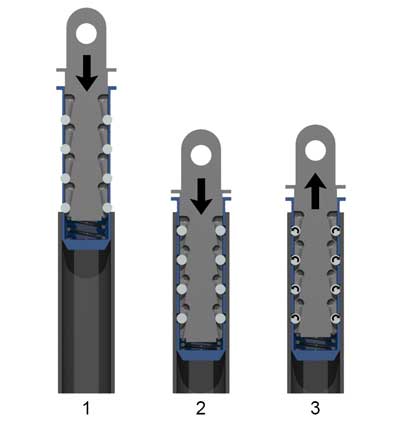
As floating wind turbines move into deeper waters, the capital expenditure (CAPEX) costs for mooring and installation will contribute a significant proportion of the overall project budget. Offshore wind developers are looking for a new mooring methodology to reduce costs, minimise installation times and reduce health and safety risks. The mooring of offshore wind platforms has been identified as the critical success factor in the future of floating offshore wind. High installation costs and the cost of anchoring are delaying and restricting the commercialisation of the sector.
By Greg Campbell-Smith, Global Business Development Manager, First Subsea, UK
During the past five years, a number of floating offshore wind mooring concepts have been developed; progressing from conceptual design, to test tanks and then to the deployment of full-scale prototypes. Here we describe how established offshore oil and gas technology can be incorporated into these mooring systems, offering the renewables industry an innovative and sustainable solution to a significant technological and expensive challenge.
- Details
- Category: Articles
 Faster Failure Detection in Wind Turbine Drive-Trains
Machine learning is finding its way into wind energy. It can be beneficial in many aspects of the wind industry value chain, ranging from the planning phase of new farms to operational optimisation during their service life. For the latter it has big potential. A turbine has many sensors that allow detailed monitoring of its operation and this operational data can be used as input for machine learning strategies. By tailoring maintenance strategies to the information coming from anomaly detection based on monitoring algorithms maintenance can be optimised and turbine uptime improved. In particular by using already available SCADA sensor data, optimisation potential can be realised rapidly.
By Prof. Jan Helsen and Ing. Pieter Jan Jordaens, OWI-lab, Belgium
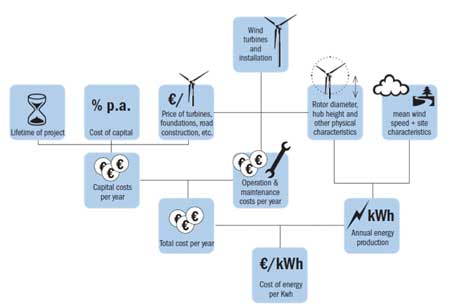
In order to keep increasing offshore wind energy’s market share it is necessary to further reduce the cost of electricity from this source. Figure 1 shows a typical cost breakdown for a wind energy project. Operation and maintenance (O&M) costs are an important cost driver, especially since these costs recur during the complete span of the project. Therefore, reducing O&M-related cost has a direct influence on the total cost of energy.
- Details
- Category: Articles
 Europe’s Wind Productivity to Rise 30%
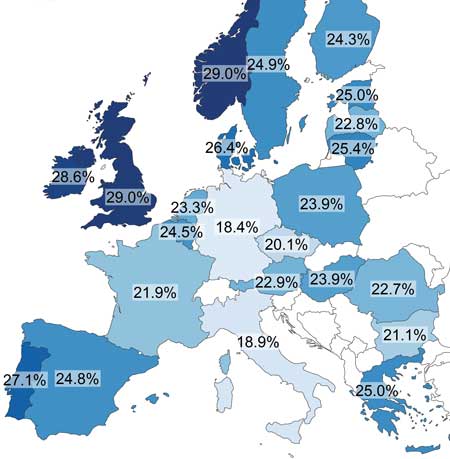
Researchers from Imperial College London and ETH Zürich have developed a new multi-decade simulation of wind power production in Europe. Using global weather data from NASA, they estimated the hourly output from tens of thousands of wind farms that are currently operating or in the planning pipeline. With this, they found that technical improvements over the last ten years have led to significant increases in average capacity factors – and that the continued move towards larger machines placed further offshore will see this continue into the future. They predict that Britain’s capacity factor will rise from 32 to 39%, and Germany’s from 19 to 29% because of large developments in the North Sea, whereas capacity factors in Spain and Italy will see more modest growth due to limited new investment. Their research has led to the development of a new open-access tool that can simulate wind and solar power anywhere in the world, which is available at www.renewables.ninja.
By Iain Staffell, Imperial College London, UK, and Stefan Pfenninger, ETH Zürich, Switzerland
There has been a massive boom in wind power capacity both in Europe and worldwide. In 2015 global installed capacity passed 350GW, with 135GW installed in Europe, distributed across some 87,000 wind turbines grouped into 17,000 wind farms. Wind power now provides 13% of Europe’s electricity, more than nuclear power.
- Details
- Category: Articles
 Making Life Easier and Safer for Technicians
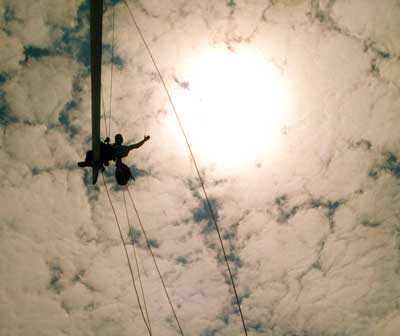
Technical innovations are constantly influencing the way blade repair is conducted within the wind sector, as project owners seek to shorten inspection and maintenance times, make the most of short service windows and increase the longevity of their assets by incorporating the latest technology into their strategies. In this article Tom Dyffort, Managing Director of blade repair and inspection specialist Altitec, discusses the five technological advancements that have most influenced the sector over the last decade.
By Tom Dyffort, Managing Director, Altitec, UK
Power Ascenders
Clambering up turbine towers and along blades would be an infinitely more difficult task without the power ascender systems, such as the ActSafe Ascender, which most rope access blade repair technicians now rely on to carry out a majority of their work. These powered rope ascender systems were first introduced to the industry in 1997, and are currently being rolled out across the European onshore and offshore wind sectors.
- Details
- Category: Articles
 Lifting in Confined Spaces
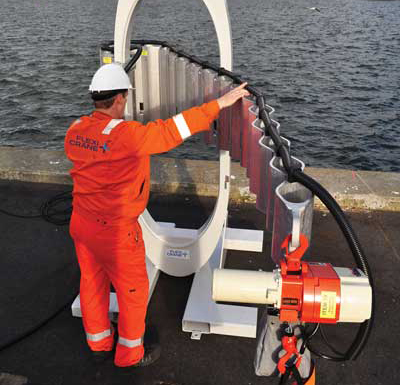
Lifting in a confined space can be both dangerous and difficult. Very often there is not enough room for a conventional crane or a traditional lifting device, so the employee ends up performing the heavy lifts manually. It takes time, and unfortunately it also causes a great number of personal injuries every year. This article focuses on the safety aspects of lifting in confined spaces such as inside wind turbines and illustrates how a flexible crane can make it possible to cut manual handling to a minimum.
By Jesper Friis-Wandall Nielsen, Sales Director, FlexiCrane, Denmark
A flexible crane that is easy to use and which can move loads around corners and obstacles, through narrow openings and in all directions provides wholly new possibilities and means a major difference to safety and the working environment.
- Details
- Category: Articles
A Grease with Low Base Oil Viscosity Improves Main Bearing Lubrication
The lubrication of main bearings in wind turbines is a difficult business. The lubricant has to cope with false brinelling, with challenging operating aspects such as high loads and varying temperatures, and with the need to protect components against wear. Last, but not least, lubricants have to be useable in centralised 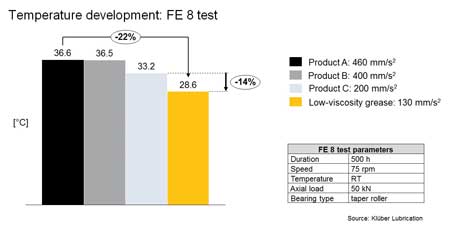 lubricating systems. The classical approach in wind turbine main bearing lubrication has been to use greases with a high base oil viscosity, which were regarded as the optimum. Meanwhile, bench tests and field experience have shown that greases with a low base oil viscosity (i.e. in the range of 130–150mm/s2) can protect the bearing better than other lubricants. The key to success is the combination of the low-viscosity base oil with suitable extreme pressure and antiwear additives.
By Thomas Jørgensen, Klüber Lubrication, Germany
Increased Challenges for Wind Turbines
Wear protection under high loads and vibrations, good grease distribution, efficient oil separation and reduction of component temperatures are some of the issues which need to be considered, especially for main rotor bearings in both geared and direct-drive turbines. There are further challenges for manufacturers of lubricants from developments in turbine technology. One development has been the tendency for turbines to have higher power generation capacities, which also means that they have bigger and heavier rotor bearings. A second trend has been the requirement of longer lifetime (i.e. a minimum of 20 to 25 years). These conflicting requirements make the main bearing an extremely challenging application. Mechanical challenges which have been known from the early days of wind turbine design are becoming even more obvious with increasing turbine dimensions. The fact that the bearings operate at low speed and, at the same time, are subjected to alternating loads and torques with constantly varying directions of loads and movements, are problems that the industry is still trying to solve using a variety of techniques.