



- Details
- Category: Articles
Market Demand Drives Development of New Solutions
With the growth of the wind industry and introduction of turbines of more than 1MW, greater loads and increased stresses are affecting mainshaft and gearbox bearing life. Damage and failure modes are occurring sooner than expected, and for many wind farm operators the cost of unexpected down-tower repairs is adding up. As a result, the industry is asking for longer life from mainshaft and gearbox bearings.
By Guillaume Badard, The Timken Company, France
Current Design Challenges
Modular wind turbine designs commonly use two-row spherical roller bearings (SRBs) to support and carry the mainshaft loads. In fact, SRBs dominate the modular turbine market in two different configurations, three- and four-point mounts. These configurations are shown in Figure 1.
- Details
- Category: Articles
 How to Use the Whole Potential of Wind Farm Data
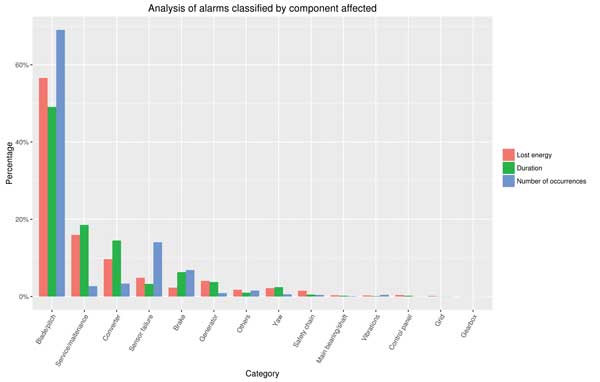
Wind farm SCADA data holds an enormous potential for plant performance improvement and should be an essential tool for operation and maintenance (O&M). The proper analysis of key variables can lead to important benefits through the improvement of turbine performance, as well as cost reductions through optimisation of the O&M strategy and extension of the lifetime of components. Because of the huge amount of information contained in SCADA, specific analysis techniques need to be designed and applied to get the most from the data. In the following article, the authors explain some of the best available methods for SCADA data analysis, the most common issues identified in operational wind farms and the benefits obtained through this kind of analysis.
By Claudia Puyals, Plant Performance Analyst, AWS Truepower, Spain
Wind farm SCADA contains a large amount of highly valuable information that in most cases is not exploited at its maximum level. In general, only a small fraction of SCADA data is analysed, even for those wind farms integrated into control centres. Furthermore, the analysis is frequently only superficial.
- Details
- Category: Articles
 A Forestry Focus
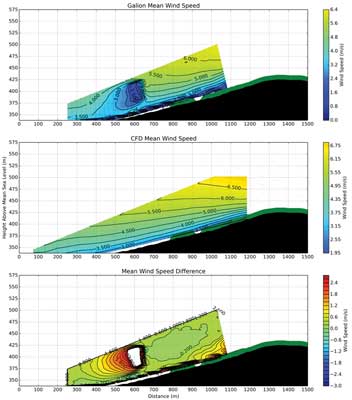
As existing wind farms are maturing, owners and operators are beginning to scrutinise operational performance, placing additional focus on performance enhancement. Considerable attention has been paid, in recent years, to reliability and maintenance optimisation, but the focus is now intensifying on making the most of existing assets and, importantly, their return on investment.
By Alan Mortimer, Director of Innovation, SgurrEnergy, UK
Technology advances and a more in-depth understanding of wind is beginning to show that, in many cases, wind farms have not been optimally designed for real on-site wind conditions and related constraining factors. The opportunity exists for wind farm owners to realise substantial commercial gain through improvements that are focused on control, aerodynamics and the local environment.
- Details
- Category: Articles
 Lessons Learnt and Future Opportunities
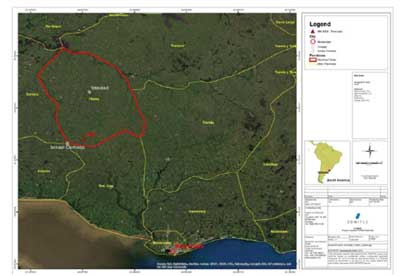
In August 2012 SOWITEC won the tender for Vientos de Pastorale (Pastorale), a Uruguayan wind farm in the southwest of the country (Figure 1) and was granted a 20-year power purchase agreement (PPA) at a price of US$ 63.5/MWh. On 23 February 2016 financial close was successfully reached on the debt and equity components for Pastorale. The close is the first in the country to be carried out with commercial lenders and on a non-recourse basis. It allows start of construction on time and commissioning before mid-2017. Lessons learnt in the areas of technology, standardisation of tender documentation and lending are presented below. Opportunities for the country’s wind power system are also addressed.
By Rosa Tarragó, Head of Structured Finance, SOWITEC, Germany
As indicated in the figures published by the Global Wind Energy Council (GWEC) in April 2016, Uruguay has experienced rapid development in the wind energy sector since 2010. At the end of 2015 the country’s total wind power capacity amounted to 845MW, supplying 19.5% of the country’s electricity demand.
- Details
- Category: Articles
Detecting Faults Long Before the Damage
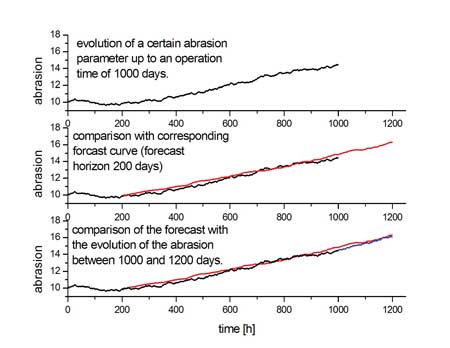 A key term of Industry 4.0 is ‘predictive maintenance’ – the forecast of damaging events long before they occur. The software company Indalyz Monitoring & Prognostics (IM&P) GmbH, which is based in the city of Halle (Saale) in the German Federal State of Saxony-Anhalt, has developed an innovative predictive maintenance software solution. This software is based on artificially intelligent algorithms that forecast when an individual component of a machine, complex plant or a machine cluster will reach its critical level or even break down. Future malfunctions are predicted long before the damage event occurs. The operator of a facility such as a wind park can thus organise service, material and personnel efficiently, which in turn reduces the operating costs and downtimes.
By Prof. Dr. Michael Schulz (IM&P) and Tanja Ruedinger (Investment and Marketing Corporation Saxony-Anhalt), Germany
Modern machines have a highly complex technical structure which makes them very costly and maintenance-intensive. It therefore makes economic sense to use each component up to the loss of functionality but at the same time to minimise maintenance costs and reduce downtimes to a minimum. To achieve all this, a pioneering maintenance concept is needed: predictive maintenance.
- Details
- Category: Articles
An Early Stage Innovation for Floating Offshore Wind Applications
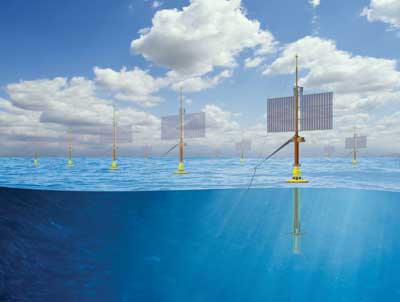 Offshore wind turbines are immense and mechanically complex. Their energy is also relatively expensive. Electrohydrodynamic (EHD) wind energy is a new way to produce power by converting the kinetic energy of offshore winds into electricity with mechanical simplicity. It could dramatically reduce the cost of offshore wind energy generation and increase capacity factors to well over 50%, enabling faster growth of this renewable power capacity worldwide. A recent US$ 4.9 million award from ARPA-E is funding a collaboration between small company innovator Accio Energy Inc. and the University of Maine’s Advanced Structures and Composites Center to design, build and test the first sub-scale prototype off the coast of Maine, as well as to validate a transformative LCOE model of a full-scale design.
By Jennifer Baird, CEO, and Dawn White, President and CTO, Accio Energy, USA
Accio Energy’s innovative approach to offshore wind energy harvesting could create a new, lower-cost offshore wind option to accelerate development of the US and global offshore wind market, helping to mitigate the impact of greenhouse gas emissions and climate change risks.
- Details
- Category: Articles
Becoming Flight Ready with the Latest UAV Systems
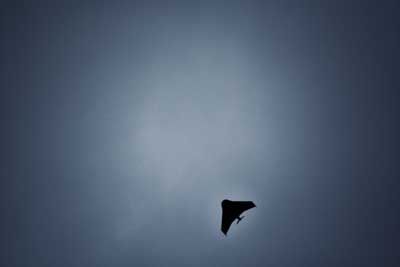 Natural Power is an independent renewable energy consultancy renowned for early adoption of successful technologies. Understanding complex environments and engineering challenges is the focus of a large number of renewable energy experts who make up this organisation. A recent investment has been made into aerial survey technology to enhance renewable project understanding across all phases of development. This article aims to provide a short review of fixed-wing aerial survey technology, details of equipment, key deliverables, primary benefits and safety controls. There are undoubtedly many unmanned aerial vehicle (UAV) manufacturers and systems available, with technology continually advancing. This review examines Natural Power’s experience in acquiring a Trimble Navigation ‘UX5’ aerial imaging platform.
By Gavin Germaine, Senior Geotechnical Engineer, Natural Power, UK
UAVs, drones and RPAS (remotely piloted aircraft systems) are just a few of the increasing numbers of terms used to describe the rise of latest technology to enter the skies.