



Nordex expands Delta4000 series with N193/7.X turbine
- Details
- Category: Product News
Nordex is expanding its Delta4000 series with the new N193/7.X wind turbine. The turbine will be available in several nominal capacity configurations, allowing it to be adapted to different market requirements.
TGS | 4C launches onshore wind intelligence platform
- Details
- Category: Product News
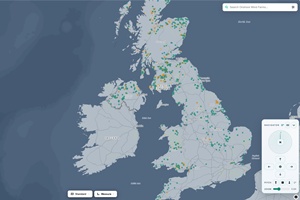 TGS | 4C has launched a new Onshore Wind Intelligence Platform, providing project-level information on the European onshore wind market. The platform brings together project, supplier and market data in one resource. It is aimed at developers, suppliers, analysts, financiers, policymakers and strategy teams, and links project activity with the organisations involved.
Dajin selects Ulstein HX122 for offshore installation vessel
- Details
- Category: Product News
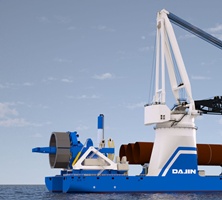 Dajin Heavy Industry has selected the Ulstein HX122 design, featuring the U-STERN hull solution, for an offshore installation vessel. The vessel has been designed by Ulstein Design & Solutions in the Netherlands and is intended for installing monopiles, jacket foundations and offshore substations for offshore wind projects.
Connecticut joins lawsuits over offshore wind lease cancellations
- Details
- Category: Industry News
Connecticut Attorney General William Tong has joined six other attorneys general in two lawsuits challenging agreements between the Trump administration and developers to cancel four planned offshore wind projects.
California files lawsuit over Invenergy offshore wind lease buyout
- Details
- Category: Industry News
California Attorney General Rob Bonta and the California Energy Commission (CEC) have filed a lawsuit against the Trump administration and Invenergy over an agreement to terminate Invenergy’s offshore wind lease in the Morro Bay Wind Energy Area off the central California coast.
SeaTwirl signs MoU for 20 MW floating wind project in Australia
- Details
- Category: Projects and Contracts
SeaTwirl and Australian company Hunter Floating Offshore Wind (HFLOW) signed a five-year Memorandum of Understanding (MoU) on 22 September 2026 for a proposed 20 MW floating offshore wind demonstration project off Newcastle in New South Wales, Australia. HFLOW is responsible for project development activities in Australia, including permits, stakeholder engagement, financing, port and grid connection. SeaTwirl will contribute its technology, a reference design and engineering support.
Oman to host 23rd World Wind Energy Conference in 2027
- Details
- Category: Conferences and Exhibitions
The World Wind Energy Association (WWEA) Board has announced that the 23rd World Wind Energy Conference (WWEC2027) will be held in Oman. The event will be co-organised by Nama Power and Water Procurement and WWEA, with support from Oman’s Ministry of Energy and Minerals.
TotalEnergies brings power activities together under Integrated Power Germany
- Details
- Category: Company News
TotalEnergies is reorganising its power business in Germany and will bring its activities together under a new business unit, Integrated Power Germany. The unit will bring together QUADRA energy Sales & Origination, Kyon Energy and VSB, as well as TotalEnergies’ offshore wind activities in Germany.
Vestas announces orders in Germany, Sweden and North America
- Details
- Category: Projects and Contracts
Vestas has received an order for an undisclosed project in Germany. The order comprises five V162-7.2 MW turbines and two V150-6.0 MW turbines, together totalling 48 MW.
Navaris secures 304.5 MW in latest onshore wind auction
- Details
- Category: Projects and Contracts
Navaris has secured awards for 11 onshore wind projects in Germany’s latest auction. With a combined capacity of 304.5 MW, all of the company’s submitted bids were successful. The awards cover 46 wind turbines and account for more than 12% of the total capacity awarded in the auction.
- ZF Wind Power launches modular powertrain platform
- Indexation could reduce offshore wind project costs in Germany
- BGB launches circularity collection service
- Enercon launches financing fund for wind projects
- Onyx Insight launches Cortex platform for wind turbine monitoring
- deugro opens wind turbine component handling facility in Antwerp
- We4Ce and Adios Technology combine operations under eProWind
- Flender presents new generator concept for wind turbines
- Huisman to deliver cranes for Cadeler’s T-class vessels
- Offshore wind investment remains under pressure
- Jotun report highlights challenges to wind project profitability
- Vestas introduces V182-7.2 MW wind turbine
- German onshore wind auction awards 2.52 GW
- European Energy wins support for 89.6 MW in German wind tender
- Eiffage joint venture wins second 2 GW offshore converter platform contract
- Ørsted tenders for bird and bat monitoring in Polish Baltic Sea
- Revolution Wind completes turbine installation off Rhode Island
- Inauguration of He Dreiht offshore wind farm
- HybridGenerator introduces HG Lite for temporary power at wind farm construction sites
- Oracle invests in 1.7 GW of wind generation in Texas
- Masdar and Taaleri Energia inaugurate 154 MW Čibuk 2 wind farm
- Masdar signs agreements on German offshore wind and battery storage
- Studio Rinnovabili appoints Iva Lubenov as Head of Construction
- Construction starts on TeneT’s second 2 GW jacket
- Vineyard Wind and GE Vernova resolve commercial litigation
- Qualitas Energy launches Navaris as new German brand
- Prokon selects OneView for 918 MW wind fleet
- CNC Onsite to open US subsidiary
- Vestas announces three orders totalling 119 MW
- Enerpac introduces new hydraulic pumps and tool storage system