





- Details
- Category: Articles
Who Signs Off on AI?
Blade inspection is the flagship use case whenever offshore wind talks about artificial intelligence (AI). Drones capture thousands of images; AI classifies the defects; decisions get faster and cheaper. This January, RWE and its partners flew the first autonomous drone inspection of an offshore turbine while it stayed in operation, which is a genuine technical milestone. At the same time, a classification society is now building a validation standard because it is not yet convinced the tools are reliable. Published research puts current detection accuracy well short of what a sign-off decision needs. And not one offshore wind insurer will say publicly whether AI-generated inspection data holds up as evidence.

By Dimitry Adamyan, Principal Account Executive, Fluix, Ireland
- Details
- Category: Articles
The Case for Robotic Quality Checks in Blade Factories
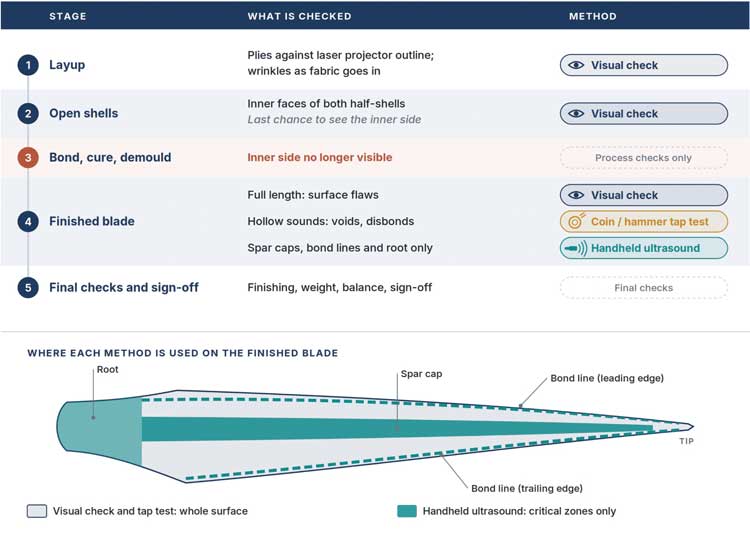
Most of a finished wind turbine blade is still checked by people walking its length with a small hammer and a handheld ultrasound probe. Instrumented checks usually cover only the most critical zones. Yet the defects that matter most, such as fibre wrinkles inside the laminate and weak bond lines between the shells, are often the hardest to see. This article looks at why blade inspection has stayed largely manual. It explains why automating inspection is a more practical first step than automating lay-up and what a realistic robotic inspection set-up could look like. Finally, it sets out how a manufacturer could start small, what to measure, and what to expect in the first year.
By Pravin Luthada, CEO and Co-founder, Addcomposites, Finland
- Details
- Category: Articles
Lightning Management Across a Wind Farm
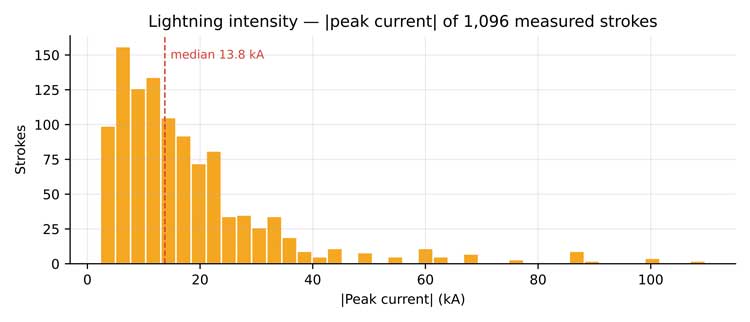
Lightning is a leading cause of unplanned blade repair, but operators rarely know which turbines have been struck or how well remote detection reflects events at the tower. This case study reports one lightning season of on-tower strike monitoring across more than 100 turbines at a single site. The analysed event records span October 2025 to May 2026. The sensors recorded 330 confirmed strike events, 292 of them assigned to 16 storms, and 91% of the monitored turbines were struck at least once. The events were cross-checked against two commercial lightning location service networks. Network A matched 84% of the 292 events it could be assessed against, and Network B 79% of the full 330. The article characterises the season’s strike population, quantifies how closely each network agrees with the on-tower turbine sensor, and reports the 16 turbines with new blade damage found in the 2026 inspection, which could all be traced to confirmed strikes.
By Elizabeth Beavis, Tilt Renewables, Rosemary Barnes, Pardalote Consulting, and Matthew Stead, eologix-ping, Australia
- Details
- Category: Articles
Crowbar Resistors Shield Converter Electronics When Grid Faults Emerge
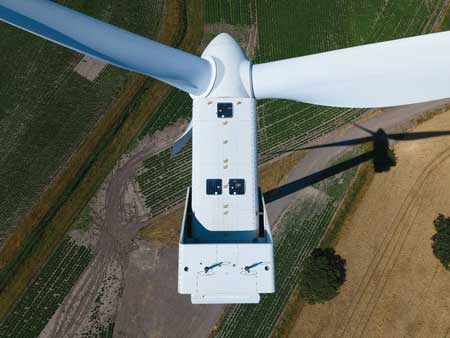 Wind turbines are built to withstand harsh weather and operating stresses, but a less visible risk comes from the grid itself. When a fault occurs, rapid changes in stator flux can induce damaging transient voltages and currents in the rotor circuit. The power electronics, often housed within the nacelle, are particularly exposed to these electrical disturbances. This article explains how crowbar resistors protect turbines from the grid itself.
By Mike Torbitt, Managing Director, Cressall Resistors, UK
According to the GB Grid Code, generating plants must remain stable and connected during defined grid faults, including faults lasting ‘up to 140ms in duration’ [1]. The requirements also set expectations for how generating plants respond to longer voltage dips, depending on the retained voltage.
- Details
- Category: Articles
 128-Channel LDV Measures Operating and Static Tower Dynamics
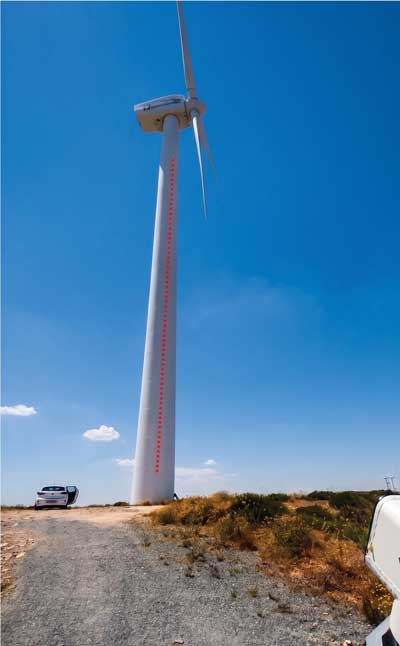
Wind turbine towers are large structures whose dynamic behaviour changes as rotor loading, drive-train coupling, and ambient wind interact. That makes modal interpretation difficult when the measurement method is slow, sparse or intrusive. This article summarises a field campaign carried out in Las Navas del Marques, Avila, Spain, where Ommatidia LiDAR used a 128-channel laser Doppler vibrometer (LDV) to observe a real turbine tower under both moving-rotor and static-rotor conditions. The result was a spatially resolved view of how the same structure behaves with and without operational forcing, captured in roughly 2 seconds and without mounting sensors on the tower.
By Oscar R. Enríquez Paz y Puente, Product Specialist, Ommatidia LiDAR, Spain
Reliable tower dynamics start with one practical question: can engineers capture enough spatial information, fast enough, to separate structural behaviour from operational forcing?
- Details
- Category: Articles
 Advances in Lidar Turbulence Intensity and Data Recovery
Accurate turbulence intensity (TI) and high data availability have long been the two weak points of stand-alone lidar campaigns. TI directly drives turbine loads and site suitability, yet lidar measurements historically diverged from trusted cup anemometers. At the same time, low-aerosol conditions, fog and precipitation have limited how much usable data wind lidars could recover, especially at modern hub and tip heights. New physics-based reconstruction and deep learning availability algorithms for WindCube vertical profiling lidar now address both challenges. WindCube Pure TI reconstructs cup-equivalent TI from 1Hz line-of-sight data, while the Availability Booster recovers valid measurements that previously sat below traditional carrier-to-noise ratio thresholds without inflating uncertainty. Validated across dozens of sites and systems and now accepted by a major turbine OEM for site suitability, these techniques are reshaping how developers design campaigns in complex terrain and low-aerosol environments.
By Romain Guillaume, Senior Product Manager, Vaisala Energy and Environment, France
Wind resource campaigns at modern sites increasingly rely on lidar for flexibility, height coverage, and permitting advantages, but two questions have constrained its wider use as a primary or stand-alone solution: can lidar turbulence intensity (TI) replace mast measurements and can availability remain high where aerosols are scarce?
- Pulse-Echo Ultrasound for Pitting
- Epoxy Coatings for Offshore Wind
- Wanted: A Blade Erosion Hero
- Beyond Hub Height: Offshore Wind Forecasting Goes Vertical with Artificial Intelligence
- Repairable and Recyclable Rotor Blades
- Wind Ramps and Energy
- Integration by Design
- Offshore Wind Arrives in the Northeastern USA
- Trusting the Wind Supply Chain
- AI Transforming Floating Offshore Wind
- Engineering Metrology for Offshore Wind Manufacturing
- AI-Powered Monitoring at DemoSATH
- Reaction-Free Torque-Controlled Tightening of Large Diameter Bolted Joints
- Digital Solutions Boost Turbine Monitoring
- Wind Turbine Blade Transportation
- Preventing Blade Bearing Damage
- A Scalable Approach for Higher Heights and Production Volumes
- AI-Driven Prescriptive Maintenance
- Lidar Measurements for Tall Turbines
- Noise Curtailment Optimisation Strategies
- Remanufacturing Rotor Blade Inserts On-site
- Fill-For-Life Lubrication Technology in Wind Energy
- Does Distance Really Matter in Met Campaigns?
- Heavy Maintenance for Floating Wind
- How Real-Time Data is Redefining Offshore Wind Planning
- Infrasound Near Wind Turbines
- Blade Tip Extensions: Boosting Turbine Output
- Six-Month Wind Energy Forecasts
- Interactive App for Understanding the Impact of Wind Turbines
- Anchoring Solutions for Floating Renewables