



- Details
- Category: Articles
 Exploring New Technologies for Extreme-Scale Turbines
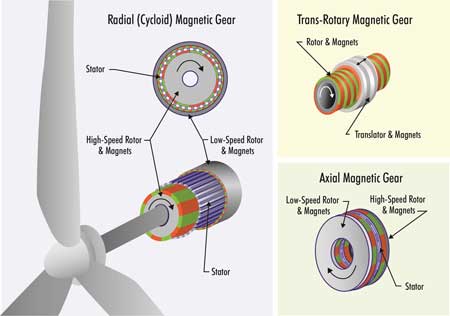
Larger turbines – beyond today’s multi-megawatt onshore and offshore machines – are one of the most attractive options for reducing the cost of wind energy. Continued technology scale-up to rated capacities of 10MW and beyond requires novel concepts for overcoming the fundamental limitations of today’s turbine designs and materials, including structural constraints of drive-train components. This article explores how magnetic gearbox technologies could provide solutions.
By Luis Cerezo, Technical Executive, EPRI, USA
Basic Science
Magnetic gears rely on field forces, rather than physical contact between gear teeth, to achieve high ratios at greatly reduced mass and size relative to mechanical gearboxes used in today’s wind turbines. Magnetic gearing promises to alleviate constraints to increasing wind turbine ratings above 10MW while also increasing efficiency, improving reliability and reducing levelised cost of energy.
- Details
- Category: Articles
 How to Calculate the Remaining Useful Life (RUL) of Wind Farms
Wind farms are part of our surroundings and therefore are in general fairly accessible power generation facilities. Safety is key to both continuation of operations and a corporate responsibility towards workers and third parties. It must be safeguarded through a comprehensive process including analytical RUL calculation, inspections and certification to confirm that there is a limited risk exposure while the installation continues operating. Once the real status of the wind turbines is characterised, smart operational strategies can be deployed to maximise the return on the investment.
By Jose Javier Ripa, Business Development Manager, UL DEWI, Spain
Calculating RUL
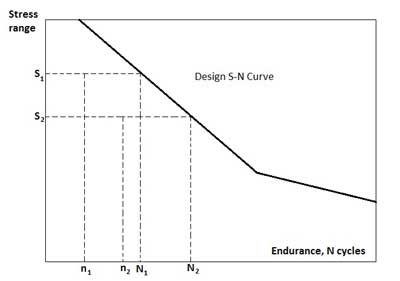
RUL is calculated by comparing the number of cycles, performed at critical locations (load stations) on the aeroelastic model, under two scenarios of power production and external conditions. The scenarios are:
- Details
- Category: Articles
Reducing Cost and Risk in Floating Offshore Wind
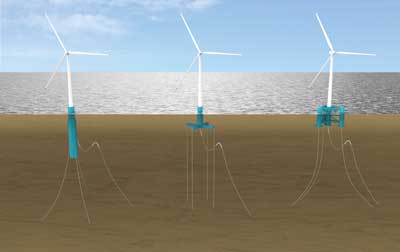 In recent years, floating wind has gradually matured as a technology, progressing from being the subject of academic research to a handful of full-scale, stand-alone prototype projects (Hywind in Scotland, Principle Power in Portugal and the FORWARD project in Japan), to the development of multiple pre-commercial arrays. Technological advances in floating wind will open up opportunities to exploit the abundant wind resource in deeper water sites where it is currently not possible to deploy fixed-bottom foundations, making this an important area of research for the offshore wind industry. This article analyses the costs and risks of the three most common types of floating wind structure and compares them to those of a fixed-bottom monopile wind farm. It also provides an outlook on the technology’s future and notes areas where further research is needed.
By Robert Proskovics and Gavin Smart, ORE Catapult, Glasgow, UK
Floating wind still lags far behind fixed-bottom wind in terms of commercial readiness and will rely on governmental support in the medium term if it is to achieve – or even outstrip – costs associated with conventional fixed foundations in the long term. However, as floating wind moves closer to full commercialisation, new supply chain opportunities are emerging. The natural synergies with the oil and gas sector mean this technology offers potential for those affected by the recent downturn in the oil and gas industry.
- Details
- Category: Articles
Anticipating Quarterly Winds and Revenues One Month Ahead
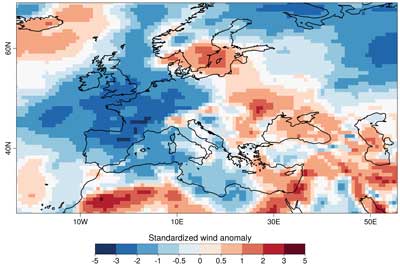 The wind power industry has traditionally used fixed climatologies for anticipating wind speed and wind generation beyond 15 days ahead. However, wind is highly variable at monthly and seasonal scales, and anomalies occur around the globe every now and then. Assuming that future conditions will be similar to average past conditions has several inherent shortcomings. Recent advances in dynamical modelling systems have opened new opportunities for seasonal prediction of wind speed that can improve current practices. Ensemble ocean–atmosphere numerical simulations can provide meaningful forecasts that indicate the probability of having above-normal, normal or below-normal wind conditions in the next season with one month of advance warning. Through an analysis of some case studies we will explore in this article how seasonal predictions of wind speed and generation have been made possible, what their quality is and how they can help in the decision-making processes for practical applications.
By Llorenç Lledó, Barcelona Supercomputing Center, Barcelona
Seasonal predictions of wind speed can be useful to many stakeholders for a number of purposes: determining optimal periods for maintenance activities (especially offshore), helping grid operators to anticipate grid balance problems, or assisting in energy trading decisions. Hereafter we will focus on their application for anticipating revenues and cash-flow problems.
- Details
- Category: Articles
A Revolutionary Concept Featuring a Ring-Shaped Generator
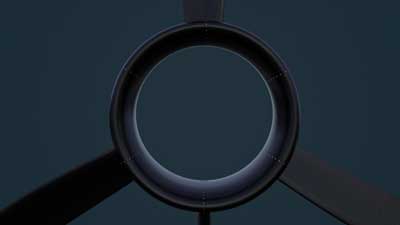 Members of the MegaWindForce (MWF) team developed a highly efficient variable transmission system back in 2012. While researching whether this invention would contribute to the efficiency of wind turbines they became aware of the catch 22 situation of the wind industry: rotors need to be bigger to harvest more energy, resulting in lower numbers of revolutions, which makes the design of generators more complex and relatively more expensive. A new concept was developed, where the main shaft was replaced by a ring. This revolutionary concept resulted in several patents.
By Ton Bos, co-founder and shareholder of MegaWindForce, The Netherlands
Concept
One of the most severe challenges in designing a traditional horizontal axis wind turbine is optimising the blade joints to the rotor hub. With the growth of the size of turbine rotors, the driving torque at the blade root section increases more than linearly with the length of the blade (with the rotor radius cubed). When the same materials are used, the weight increases cubically with size, demanding heavier constructions to withstand forces. The low number of revolutions made it necessary for the nacelle to grow for the direct drive generators or introduced heavy gearboxes. By replacing the main shaft by a ring-shaped generator-support combination the disadvantages of classical upscaling are eliminated.
- Details
- Category: Articles
Life-cycle Engineering Asset Management
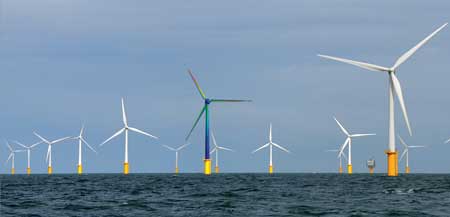 International research and engineering solutions company TWI Ltd has set its sights on harnessing digital twin technology to transform the process of monitoring and maintaining offshore wind turbines. TWI has built up its knowledge in the structural health and condition monitoring of wind turbines in recent years as a result of its participation in a number of European and UK collaborative projects, including CMSWind, WTBMonitor and TOWERPOWER.
By Ángela Angulo, Senior Project Leader, TWI Ltd, UK
The collective methodology of this work sought to address each component of the wind turbine in turn, first determining potential problems that could arise (e.g. the blade developing cracks or the tower corroding), then subsequently developing new monitoring solutions to mitigate part failure. 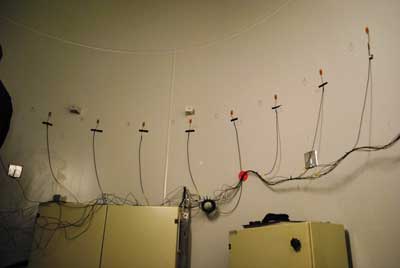 The application of digital twin technology seeks to build on this approach by replicating all the constituent components of the wind turbine into a single digital model, thereby enabling real-time monitoring of the turbine’s entire structural condition.
- Details
- Category: Articles
 District Heating and Cooling with Thermal Storage – A Virtual Battery
Wind energy is becoming a dominant renewable source, providing energy for consumers of electricity, heating and cooling. Unfortunately, few consumers can use the energy directly as the wind blows. We need storage, to avoid loss of energy.
By Anders Dyrelund, Senior Market Manager, and Søren Møller Thomsen, Energy Planner, Ramboll, Denmark
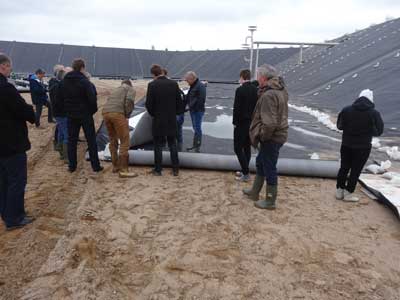
Electric batteries can offer storage capacity, but storing electricity following the fluctuations of the wind is expensive. Fortunately, district heating and cooling (DH&C) systems, which use the wind-generated electricity, can transfer electricity to thermal energy and store it for later use in a cost-effective way. Furthermore, combined heat and power (CHP) plants can generate electricity as back-up for the wind. Seen from the wind turbine, the DH&C offers the same services as a battery. In new urban developments, DH&C is cheaper than individual heat pumps and chillers. In existing Danish district heating systems, large-scale solar heating has been a driver for large seasonal thermal heat storage pits (see Figure 1), which have excess storage capacity for the integration of fluctuating wind.