



- Details
- Category: Articles
 Technology to Enhance Remote Wind Energy Staff Welfare
Wind energy providers know that retaining their most knowledgeable staff is critical to ensuring maximised operational efficiency. It’s also good business. Experienced team members perform duties more rapidly, and have more know-how to draw upon in challenging situations. But working conditions in the field can be harsh. Installations are typically remote and subject to sudden and dramatic weather changes. This article looks at what can be done to enhance the welfare of staff working in such conditions and to make sure they can be rescued when necessary.
By Gavan Murphy, Director of Marketing EMEA, Globalstar, Ireland
For both onshore and offshore wind energy field workers, risks include all the usual hazards associated with major construction and maritime projects, but these are compounded by the ever-present risk of fire. Meanwhile, access by emergency services in the event of an incident can be challenging.
- Details
- Category: Articles
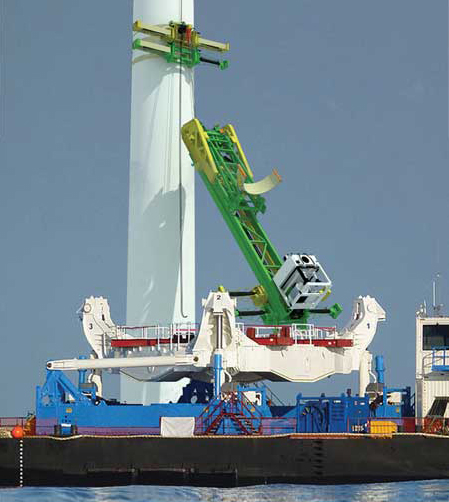 Overcoming the Problems of Size and High Wind Speeds
Wind farm sites have the annoying habit of being located in places with frequent high-speed winds! Also, the trend in the wind industry is to create bigger and taller wind turbine generators in order to produce more megawatt-hours. Unfortunately, construction and maintenance activities with the need for ever larger cranes to lift bigger loads to higher heights are not particularly compatible with high-speed winds.
By Emmanuel Garcia de la Pena, Managing Director, KoalaLifter, Spain
Because of the lack of availability of the huge cranes needed to reach the heights required and withstand high wind speeds, the wind industry is facing a significant roadblock to its development in many regions. And even where these cranes are available, their high rental and mobilisation costs make many wind farm business cases unfeasible.
- Details
- Category: Articles
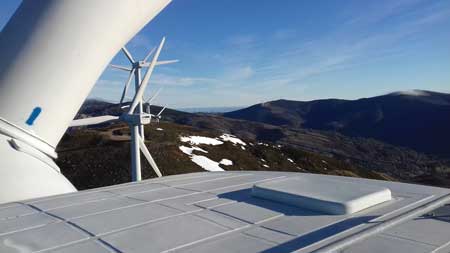 Condition Monitoring of Wind Turbines Using Non-Contact Acoustic Sensors
The reliability of drive-train components in wind turbines is still a problem. The failure of a wind turbine’s main components (i.e. gearbox, generator, etc.) usually lead to extended downtime that reduces the power generation capacity and increases the levelised cost of energy (LCOE). Vibration-based condition monitoring (CM) strategies have been widely used to reduce the downtime and schedule the maintenance programmes efficiently. However, there remain some drawbacks such as the excessive costs and intrusiveness due to contact of the accelerometers with the machinery. To solve these issues the CMDRIVE project seeks to develop a novel low cost CM solution for the drive-train based on non-contact acoustic sensors. This article describes the features of this new system including its advantages and the results of field trials in a real wind turbine.
By Juan Luis Ferrando, Senior Project Manager, Inesco Ingenieros, Spain
The Problem
Due to high competitiveness in the energy market, and because several technologies such as solar power are quickly reducing the LCOE, cost reduction is becoming crucial. For this reason, wind farm owners and manufacturers are seeking solutions to increase the reliability of their assets. Drive-train components such as generators and gearboxes are among the most critical components of wind turbines. The failure of these components incurs excessive costs, primarily due to the downtime associated with the failure. Traditionally vibration-based CM systems have been used for the diagnosis of the drive-train components of wind turbines. However, the cost of such systems is still high. This solution usually implies the installation of 8 to 12 accelerometers in the drive-train, incurring high costs and reducing the competitiveness of the wind power industry.
- Details
- Category: Articles
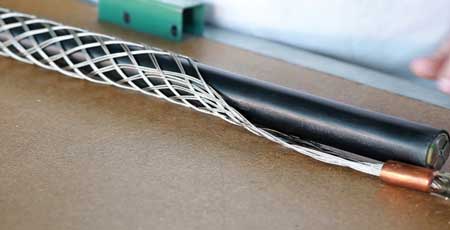 Cable Stocking with Self-Extinguishing Plastic Coating
According to power reports, with its 50,018MW of generated wind energy Germany is Europe’s leader of installed wind power plants. By the end of 2016, a total of 28,217 wind power plants supplied 12.3% of the power produced in Germany. However, although there is an increasing number of new installations, the applied technology still has its weak points. For example, recurrent fires cause significant damage and even personal injury. Fires may arise as a result of short circuits and flying sparks caused by worn-out cable insulations inside the narrow generator houses.
By Hans Benkert, CEO, rupi-Cologne, Germany
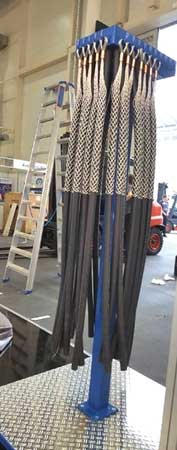 To reduce the risk of fire, in addition to securing the cables and avoiding wire breakage, rupi-Cologne has developed the rupi-Blue cable stocking, which consists of braids made of a V2 flame-retardant plastic coating. The relatively soft material avoids metal-on-metal friction, thus reducing fire risks and significantly increasing the service life of the plants.
- Details
- Category: Articles
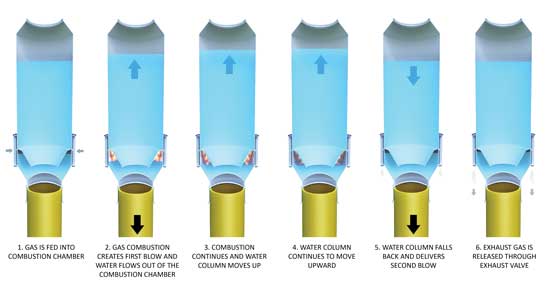 The BLUE 25M Hammer
In recent years the offshore wind industry has gained an increased awareness of the detrimental effects of underwater noise caused by pile driving. This has resulted in the need for noise mitigation measures and legislation to reduce the negative effects of foundation installation. All across Europe this legislation is getting stricter. In Germany, where the legislation is strictest, up to 40 million euros are spent per wind farm to reduce the effects of underwater noise. Fistuca BV is currently building a hammer, the BLUE 25M, that can compete with the largest hydraulic hammers in the industry, which tackles the noise issue at the source.
By Jasper Winkes, Fistuca BV, The Netherlands
Fistuca started as a spin-off from the Eindhoven University of Technology. Development of BLUE Piling Technology started in 2011. Since 2015 Huisman Equipment, a renowned equipment supplier for the offshore industry, has invested in Fistuca. In 2016 the construction of the largest hammer in the world started.
- Details
- Category: Articles
Performance Evaluation Strategies Based on Raw Data
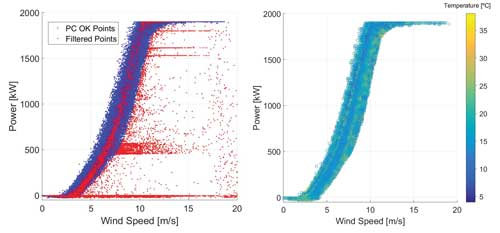 Identifying a change in the performance of a wind turbine generator (WTG) using the raw SCADA data may not be a simple task, particularly because the variability of the 10-minute values during normal operation is quite wide. This article presents four methods to evaluate the performance of WTGs over time using power, wind speed and ambient temperature SCADA measurements. We named these methods ‘Power Residuals’, ‘Health Value -PC2 Dev’, ‘Quantiles’ and ‘Power Curves Evolution’, and in each we calculate a key performance indicator (KPI). These KPIs can be useful to identify changes or trends in the operation of the turbines, assess an improvement in the performance of the WTG after maintenance is done and help in the detection and prevention of possible failures in components which are directly related to the performance of the turbines (e.g. anemometers). An algorithm to automatically identify the changes in the KPIs is also presented.
By Andres Guggeri, Martín Draper, Alvaro Díaz and Vasilii Netesov, Ventus, Uruguay
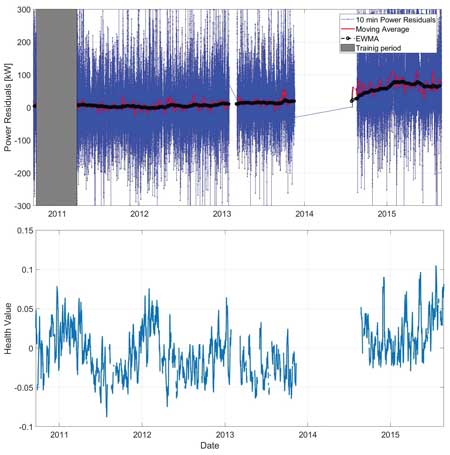 Firstly we describe the selection and filtering of the SCADA data, then the following four sections present the KPIs, depicting how they are calculated and their characteristics. We then introduce the ‘Change Detector’ algorithm and the last section shows some results of the application of these indicators to one WTG.
- Details
- Category: Articles
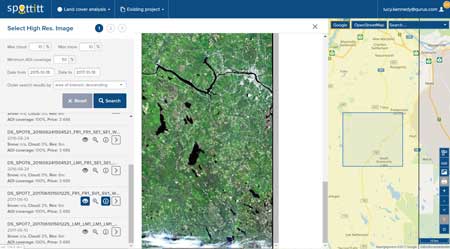 An Online Application to Remotely Select Wind Farm Sites with Suitable Geography
Spottitt is an online application that can seamlessly search and access up-to-date satellite imagery and data in order to perform industry-standard analyses that are currently executed manually. This article describes how Spottitt works and also outlines the advantages derived from the use of fully automated on-demand satellite image and data analyses, in terms of saving time and money, as well as minimising errors and human intervention.
By Marcello Deplano, CMO, Spottitt, UK
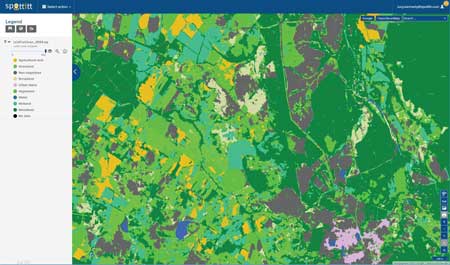 Spottitt puts onshore wind farm developers in the unprecedented position of being able to automatically scout for the best onshore wind farm locations, anywhere in the world. So far, most automation R&D in this sector has been dedicated to the prediction and modelling of wind resource availability. Far less effort has been invested in helping developers to automate the assessment of geographical, environmental and logistical constraints. With increasing turbine efficiencies, understanding these aspects in a timely and error-free fashion can be just as critical as assessing wind when it comes to minimising the cost of energy.