



Fixing it All Together
 The promise of UK offshore wind farms delivering up to a third of the UK’s power needs is pretty spectacular, and the recently announced Round 3 estimates suggest this is a reasonable expectation. So, by 2020 we are looking at around 40GW – a figure few would have predicted as likely even 15 years ago.
By Rob Humphreys, Hydratight UK Renewables Account Manager, UK
Wind power engineers could be at something of a disadvantage offshore: many are generally used to working on land, so when their construction site becomes a tiny platform out to sea, and it is costly just to gain access, it is little wonder the industry is taking advice from people already working in those conditions: namely companies maintaining and repairing oil rigs even further out to sea.
It is no surprise either that many big players in offshore oil and gas are already involved in wind farms. There are several similarities between the two industries. Both need people with experience of building large structures offshore and both have specific needs in terms of bolting and joint integrity — for oil and gas it is leak-free joints, for turbines it is about containing the tremendous stresses and vibrations.
But one area in which the two industries diverge is in jointing standards. Bolted joint integrity for oil and gas is undertaken to common standards for flanges, loads and materials: tools to assemble and disassemble such joints are generally standard. This is not the case with wind plant, where base bolts, tower joints and components within the nacelle come in a huge variety of types without even common flanges, let alone similar loadings and materials. The British wind industry currently relies heavily on products from several European makers, with all of the products built to different specifications. As UK production grows, a still wider range of new designs and loadings will be added, and when newer, larger-capacity generations of turbines arrive they will induce even greater stresses in their structures.
So the job of the constructor and, later, of the maintenance technician, is already complex and will become even more so. While technologies and failure control systems will get better, the offshore location of the huge new wind farms makes it ever more essential to build them properly in the first place. Bolted wind turbine joints might not be responsible for containing toxic chemicals at high pressure, but their failure must be just as avoidable.
If joints are not tightened to their carefully specified loads, failure is more likely. As a company Hydratight has seen rule-of-thumb loads applied in the field that could be 10% either side of the designer’s brief; any bolting engineer knows that that sort of variation can result in vibration-induced failure, if the bolt is in a critical part of the turbine structure.
Hydratight’s role in the oil and gas industry is as an engineering resource and as a specialist in bolted applications, and we operate in a similar capacity in the wind industry around the world. We make tensioning and torquing equipment that offers not only great precision, but also has the ruggedness to do so in the toughest field applications. Even on a platform in the sea, it is possible to build to a designer’s exacting specification, whatever that might be.
Our development of hydraulic tensioning systems has been deeply involved in the industry from its start: as joint integrity specialists we have worked with many major manufacturers, from Vestas and Siemens to General Electric and Mitsubishi. We have been involved at all levels, from the design and build of original components to after-market operations and maintenance activity by the eventual asset owner.
What we have come to accept is that standard tools for turbines do not exist: every design is different, so equipment makers need to be as flexible as possible.
This wide range won’t necessarily mean turbines will be erected any more slowly: after all, a technician with one company will generally work on the same equipment much of the time. But it might mean that an even bigger cache of supplementary equipment has to be carried by maintenance workers to every job, making the cost of maintenance higher and the likelihood of not using the correct tool higher – the more equipment you take, the more expensive the trip and the more mistakes that might creep in.
This variation is not ideal, but it does give companies like ours a major opportunity to do what we are very good at: not only to design and make essential equipment to tension and torque the hundreds of bolts on a typical turbine, but then to go further and adapt our designs and produce bespoke tools for specific makes and tasks.
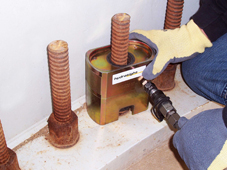
So, while our RSL range of torque wrenches continues to be the industry’s most popular, our base-bolt tensioning system was developed for a single purpose – to fix turbine towers to the foundations. In some cases, the base flange on towers is too narrow to allow standard tools to fit, so we designed one that would. The solution was an elliptical body which allows greater access in restricted positions – simple but effective. The point, of course, is that without such a specific device the tension on the bolts might not be adequate, even though the high cyclic loads of turbine operation demand that bolts within nacelles and towers are accurately and uniformly tightened to their designed tolerances. Making a specific tool was therefore both a convenience and more importantly a safety issue, directly related to the varying design characteristics of wind turbines.
Hydratight is actively involved in this sort of solution engineering because we have been around for a number of years and we have the engineering and design resources to do so. Our blade-to-bearing tensioning systems, for example, were also specifically developed to allow the OEM to quickly and accurately tension some or all of the fasteners in a joint simultaneously. The benefit is the system’s flexible ability to use any number of tools, dependent on the demands of the manufacturer and of the installation sites.
Companies like ours are dedicated to providing the right tools to make turbine working safer and more accurate, just as we do for the oil and gas industry
The right tool for the right application might seem a small element in such a big new wind power world, but these large structures rely almost exclusively on bolted assembly, so it is an element more vital than most. Better to do the job properly with the right equipment: a vast new industry’s long-term future is depending on it!{/access}
The promise of UK offshore wind farms delivering up to a third of the UK’s power needs is pretty spectacular, and the recently announced Round 3 estimates suggest this is a reasonable expectation. So, by 2020 we are looking at around 40GW – a figure few would have predicted as likely even 15 years ago.By Rob Humphreys, Hydratight UK Renewables Account Manager, UK
{access view=!registered}Only logged in users can view the full text of the article.{/access}{access view=registered}As a result of the social and engineering impetus – not forgetting the country’s naturally favourable weather – the UK’s territorial waters are set to become the biggest megawatt-hour producer of offshore wind power in the world. This is great news both for the wind industry and for others; the sort of vast project that could kick-start a new wave of British engineering.
The signs of this are already present. Earlier this year almost 2,000 companies signed up to attend offshore wind power supply-chain events, with predictions of the creation of up to 70,000 new jobs by 2020. All this is boosted by government resources to support infrastructure developments and the training of up to 75,000 adult apprentices, with promises of more help to come.Wind power engineers could be at something of a disadvantage offshore: many are generally used to working on land, so when their construction site becomes a tiny platform out to sea, and it is costly just to gain access, it is little wonder the industry is taking advice from people already working in those conditions: namely companies maintaining and repairing oil rigs even further out to sea.
It is no surprise either that many big players in offshore oil and gas are already involved in wind farms. There are several similarities between the two industries. Both need people with experience of building large structures offshore and both have specific needs in terms of bolting and joint integrity — for oil and gas it is leak-free joints, for turbines it is about containing the tremendous stresses and vibrations.
But one area in which the two industries diverge is in jointing standards. Bolted joint integrity for oil and gas is undertaken to common standards for flanges, loads and materials: tools to assemble and disassemble such joints are generally standard. This is not the case with wind plant, where base bolts, tower joints and components within the nacelle come in a huge variety of types without even common flanges, let alone similar loadings and materials. The British wind industry currently relies heavily on products from several European makers, with all of the products built to different specifications. As UK production grows, a still wider range of new designs and loadings will be added, and when newer, larger-capacity generations of turbines arrive they will induce even greater stresses in their structures.
So the job of the constructor and, later, of the maintenance technician, is already complex and will become even more so. While technologies and failure control systems will get better, the offshore location of the huge new wind farms makes it ever more essential to build them properly in the first place. Bolted wind turbine joints might not be responsible for containing toxic chemicals at high pressure, but their failure must be just as avoidable.
If joints are not tightened to their carefully specified loads, failure is more likely. As a company Hydratight has seen rule-of-thumb loads applied in the field that could be 10% either side of the designer’s brief; any bolting engineer knows that that sort of variation can result in vibration-induced failure, if the bolt is in a critical part of the turbine structure.
Hydratight’s role in the oil and gas industry is as an engineering resource and as a specialist in bolted applications, and we operate in a similar capacity in the wind industry around the world. We make tensioning and torquing equipment that offers not only great precision, but also has the ruggedness to do so in the toughest field applications. Even on a platform in the sea, it is possible to build to a designer’s exacting specification, whatever that might be.
Our development of hydraulic tensioning systems has been deeply involved in the industry from its start: as joint integrity specialists we have worked with many major manufacturers, from Vestas and Siemens to General Electric and Mitsubishi. We have been involved at all levels, from the design and build of original components to after-market operations and maintenance activity by the eventual asset owner.
What we have come to accept is that standard tools for turbines do not exist: every design is different, so equipment makers need to be as flexible as possible.
This wide range won’t necessarily mean turbines will be erected any more slowly: after all, a technician with one company will generally work on the same equipment much of the time. But it might mean that an even bigger cache of supplementary equipment has to be carried by maintenance workers to every job, making the cost of maintenance higher and the likelihood of not using the correct tool higher – the more equipment you take, the more expensive the trip and the more mistakes that might creep in.
This variation is not ideal, but it does give companies like ours a major opportunity to do what we are very good at: not only to design and make essential equipment to tension and torque the hundreds of bolts on a typical turbine, but then to go further and adapt our designs and produce bespoke tools for specific makes and tasks.
So, while our RSL range of torque wrenches continues to be the industry’s most popular, our base-bolt tensioning system was developed for a single purpose – to fix turbine towers to the foundations. In some cases, the base flange on towers is too narrow to allow standard tools to fit, so we designed one that would. The solution was an elliptical body which allows greater access in restricted positions – simple but effective. The point, of course, is that without such a specific device the tension on the bolts might not be adequate, even though the high cyclic loads of turbine operation demand that bolts within nacelles and towers are accurately and uniformly tightened to their designed tolerances. Making a specific tool was therefore both a convenience and more importantly a safety issue, directly related to the varying design characteristics of wind turbines.
Hydratight is actively involved in this sort of solution engineering because we have been around for a number of years and we have the engineering and design resources to do so. Our blade-to-bearing tensioning systems, for example, were also specifically developed to allow the OEM to quickly and accurately tension some or all of the fasteners in a joint simultaneously. The benefit is the system’s flexible ability to use any number of tools, dependent on the demands of the manufacturer and of the installation sites.
Companies like ours are dedicated to providing the right tools to make turbine working safer and more accurate, just as we do for the oil and gas industry
The right tool for the right application might seem a small element in such a big new wind power world, but these large structures rely almost exclusively on bolted assembly, so it is an element more vital than most. Better to do the job properly with the right equipment: a vast new industry’s long-term future is depending on it!{/access}