



 Often in describing a wind farm or introducing new wind projects the number of households receiving power from that wind farm is mentioned. For instance, it is said that the project supplies power to 250 households. Such a statement is very ambiguous and can be misleading. Here, I have gathered some interesting information that is not normally easily available. As well, there is a piece of stimulating information on the comparison of a steam turbine and a wind turbine.
By Ahmad Hemami, McGill University, Montreal, Canada
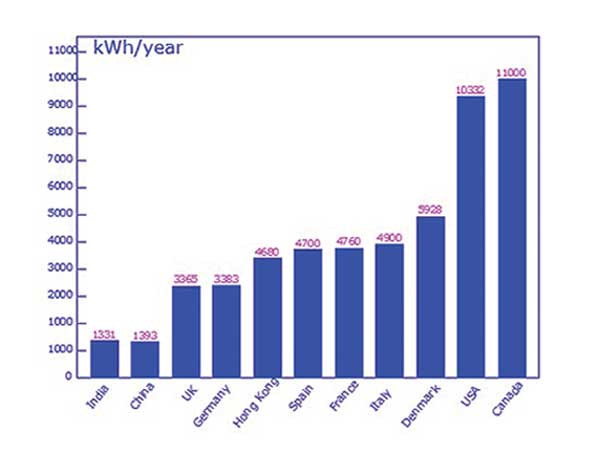
Figure 1 shows a sample of the annual electricity consumption for a few countries based on the latest available data in the past years (2022 – 2024). The consumption level is not a representative of how cold or how warm the regions of a country are. There are other factors that influence it; among them are the size of a country, its population and how spoiled the people of a country are. Nonetheless, these are average values, which do not reflect or differentiate the deviation of the average from the maximum and minimum. In this figure, the annual average household electricity consumption for Canada and India are, respectively, 11,000 and 1,331 kWh/year. This translates into 30.14 and 3.65 kWh per day.
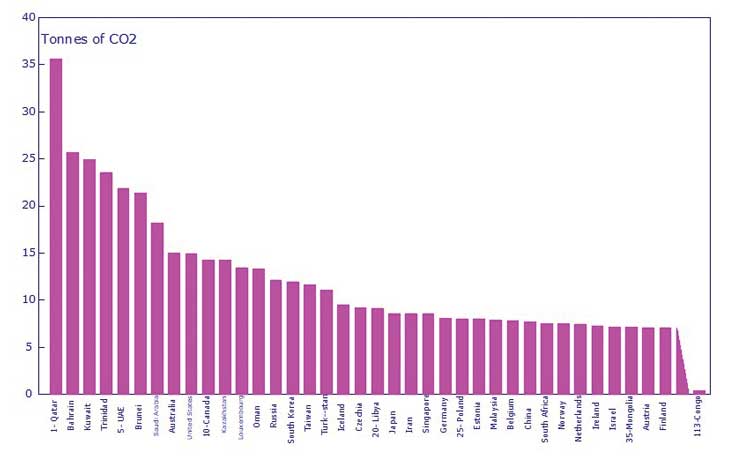
In conjunction with the numbers in figure 1, figure 2 illustrates the per capita CO2 emissions from fossil fuels in 2026 for 37 countries. This data is available for 113 countries [1]. The numbers are in tonnes of CO2.
 It is fascinating to know for a turbine how much energy is produced by one revolution of the rotor. Obviously, this depends on a turbine’s power capacity and its rotational speed. Although the largest wind turbine so far is a 26 MW unit manufactured by Dongfang Electric Corporation, for this exercise, we select the variable speed Siemens-Gamesa SG 21-276 DD, a 21.5 MW turbine, which is among the latest turbines [2] with the potential to stay in service for many years.
Although the turbine power curve was not readily available, it is not unreasonable to assume the following, which correspond to working at faster or slower winds: Its power output is 21 MW at 20 rpm rotational speed, and at 5 rpm its output is 6 MW.
Obviously, for each case we can obtain a different number. It would be further interesting to compare these numbers to that of a typical steam turbine. A steam turbine is much faster and its speed under all load conditions is the same.
The relevant calculations are straightforward; it is necessary to find the duration of time for one revolution of each case/turbine. Here, without going into the details of the calculation we just mention the results:
- In one revolution, a 21 MW wind turbine rotating at 20 rpm captures and delivers 17.5 kWh energy.
- When the same turbine rotates at 5 rpm and generates 6 MW electricity, it provides 16.67 kWh of electricity in each revolution.
- At maximum capacity, a 500 MW steam turbine running at 6,000 rpm produces 1.39 kWh energy per revolution.
Based on the numbers in figure 1, in one revolution a 21 MW wind turbine generates more than half of the daily energy needs of an average Canadian household and more than the energy needs of five average households in India.
Further reading
- World Country Data: www.worldcountrydata.com/en/rankings/co2-per-capita
- Windtech International: www.windtech-international.com/product-news/siemens-gamesa-to-develop-21-5mw-offshore-wind-turbine-prototype