



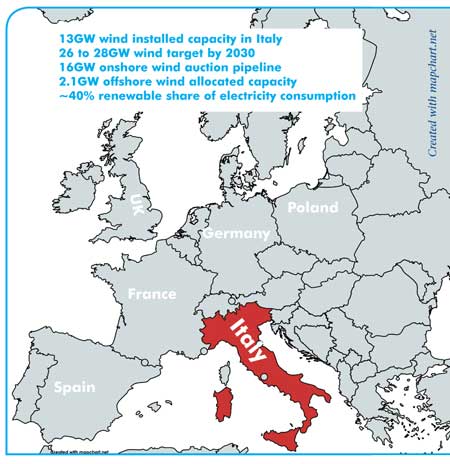
 Italy’s wind energy sector is undergoing a period of expansion and structural adjustment as the country seeks to reduce dependence on imported fossil fuels and accelerate renewable deployment. While installed capacity continues to increase, growth remains shaped by permitting delays, grid constraints, infrastructure limitations and evolving investment conditions. According to Davide Astiaso Garcia, Italy has around 13GW of installed wind capacity and more than 40GW of solar. Renewables account for roughly 40% of electricity consumption, although natural gas continues to dominate the wider energy system.
By Davide Astiaso Garcia, Secretary General, ANEV, Italy
Market Development, Competitiveness and Auction Pipeline
Italy’s modern wind sector expanded rapidly from the early 2000s, rising from around 40MW in 2000 to more than 5GW by 2010, before experiencing a slowdown between 2015 and 2020 due to lengthy permitting procedures. In recent years, market conditions have improved. Earlier phases of development were affected by higher turbine costs and grid limitations that in some cases resulted in curtailment, congestion and connection risks. These issues have gradually eased, and wind energy is now considered competitive within the Italian power market.
Onshore wind development is supported by an auction framework that is expected to allocate around 16GW of capacity over the coming years. These auctions form a central mechanism for meeting Italy’s National Integrated Energy and Climate Plan targets, which require wind capacity to increase to approximately 26 to 28GW by 2030. Current onshore auction prices are reported to be around €70–80/MWh, below wholesale electricity prices driven by fossil fuel generation. Despite this, permitting remains a key constraint, with authorisation processes taking five to six years compared with the European Union target of two years.
Offshore Wind Prospects, Infrastructure and Employment Potential
Offshore wind is emerging as a strategically important but still developing segment of Italy’s energy transition. Because of deep-water conditions along much of the coastline, future development is expected to focus primarily on floating wind technologies, with activity concentrated in Sicily, Sardinia, the Adriatic Sea and parts of the Tyrrhenian Sea.
The sector faces several structural challenges. Port infrastructure capacity must be considered a critical factor for manufacturing, assembly and deployment activities. This requirement, combined with deep-water installation conditions and evolving regulatory frameworks, makes offshore wind a particularly challenging but promising sector for Italy.
The government has introduced a support framework allocating around 2.1GW of offshore wind capacity with a strike price of approximately €185/MWh. However, auctions have not yet been launched, delaying project realisation. As a result, offshore wind is expected to contribute more significantly to Italy’s energy mix after 2030.
A joint analysis by ANEV and Sapienza University of Rome highlights the broader economic potential of floating offshore wind. The study indicates that the sector could create substantial employment opportunities, particularly in southern Italy, where unemployment rates are higher and where industrial activity linked to ports, logistics and manufacturing could be strengthened. New job creation is expected across engineering, construction, maintenance and supply chain activities.
System Integration and Long-Term Outlook
As renewable penetration increases, system integration challenges are becoming more prominent. Italy’s transmission system operator has strengthened parts of the grid, but further investment is required in energy storage, including batteries and pumped hydro, alongside hydrogen development and digitalised grid systems. Electrification of transport and heating is also expected to support system balancing and demand flexibility.
This article is based on the following audio/video WWEA podcast:
Episode 28: Wind Power in Italy: Doubling Wind Power by 2030.
https://wwindea.org/WWEApodcast