



 The European LIGHTWIND project, which is developing a new drivetrain architecture for high-power wind turbines, has completed its first test campaign and is preparing for a second phase. The next phase will introduce improvements and adjustments to the system based on the results of the initial testing. The LIGHTWIND project aims to develop an offshore wind turbine of more than 15 MW based on the OptiGen concept. This modular drivetrain architecture replaces conventional large main bearings with a wheel-and-rail system positioned close to the generator air gap.
The configuration is intended to address some of the challenges associated with increasing turbine power ratings, including larger structural dimensions and loads, higher component weights, and the maintenance requirements and costs associated with offshore turbines.
The project began with a preliminary design based on the International Energy Agency (IEA) Wind 15 MW reference turbine. The project team identified the most critical components, particularly in relation to fatigue, and analysed the operating conditions of the wheels and rails, the loads acting on them and the materials required to withstand these loads.
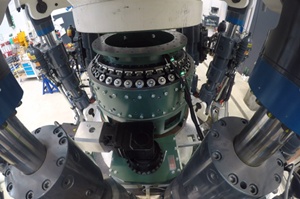
A test rig was then developed to reproduce equivalent operating conditions on an accelerated basis and assess the durability of the system. In parallel, the dynamic behaviour of the mechanical system was reproduced using a hexapod, the Beat 1.1, developed by IDOM and located at the Fraunhofer Institute for Wind Energy Systems (IWES) facilities in Hamburg. This enabled the architecture to be evaluated under demanding operating conditions.
The results from the first test campaign have enabled the project to move into a new testing phase. The technical team is implementing improvements and adjustments based on the experience gained during the initial campaign, with further validation of the concept and increased technological maturity as the main objectives.
As part of the project, a 22 MW version of the OptiGen system will also be designed using the IEA Wind Task 55 reference turbine. Its scalability to 30 MW will be analysed to assess how the architecture could be applied to future high-power wind turbines.
The development work within LIGHTWIND is also being used to explore applications of the wheel-and-rail system beyond the project’s original scope. OptiGen has assessed potential applications in other wind turbine components and architectures, including a solution for turbines with geared drivetrains and solutions for yaw and blade pitch systems.
The LIGHTWIND consortium comprises eight European companies and research institutions: TNO in the Netherlands; Fraunhofer IWES in Germany; DIS/Creadis in Denmark; HCMR in Greece; MarinRes in Norway; and Euro-Funding, X1Wind and OptiGen in Spain.
LIGHTWIND, OptiGen, drivetrain, offshorewind, Europe