




- Details
- Category: Articles
 128-Channel LDV Measures Operating and Static Tower Dynamics
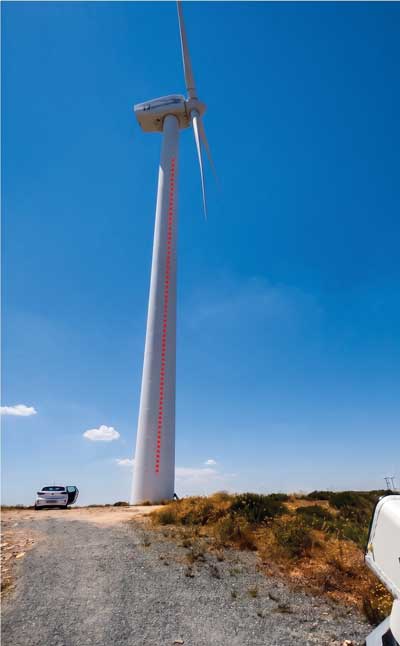
Wind turbine towers are large structures whose dynamic behaviour changes as rotor loading, drive-train coupling, and ambient wind interact. That makes modal interpretation difficult when the measurement method is slow, sparse or intrusive. This article summarises a field campaign carried out in Las Navas del Marques, Avila, Spain, where Ommatidia LiDAR used a 128-channel laser Doppler vibrometer (LDV) to observe a real turbine tower under both moving-rotor and static-rotor conditions. The result was a spatially resolved view of how the same structure behaves with and without operational forcing, captured in roughly 2 seconds and without mounting sensors on the tower.
By Oscar R. Enríquez Paz y Puente, Product Specialist, Ommatidia LiDAR, Spain
Reliable tower dynamics start with one practical question: can engineers capture enough spatial information, fast enough, to separate structural behaviour from operational forcing?
- Details
- Category: Articles
 Advances in Lidar Turbulence Intensity and Data Recovery
Accurate turbulence intensity (TI) and high data availability have long been the two weak points of stand-alone lidar campaigns. TI directly drives turbine loads and site suitability, yet lidar measurements historically diverged from trusted cup anemometers. At the same time, low-aerosol conditions, fog and precipitation have limited how much usable data wind lidars could recover, especially at modern hub and tip heights. New physics-based reconstruction and deep learning availability algorithms for WindCube vertical profiling lidar now address both challenges. WindCube Pure TI reconstructs cup-equivalent TI from 1Hz line-of-sight data, while the Availability Booster recovers valid measurements that previously sat below traditional carrier-to-noise ratio thresholds without inflating uncertainty. Validated across dozens of sites and systems and now accepted by a major turbine OEM for site suitability, these techniques are reshaping how developers design campaigns in complex terrain and low-aerosol environments.
By Romain Guillaume, Senior Product Manager, Vaisala Energy and Environment, France
Wind resource campaigns at modern sites increasingly rely on lidar for flexibility, height coverage, and permitting advantages, but two questions have constrained its wider use as a primary or stand-alone solution: can lidar turbulence intensity (TI) replace mast measurements and can availability remain high where aerosols are scarce?
- Details
- Category: Articles
A Monitoring Approach for Offshore Steel
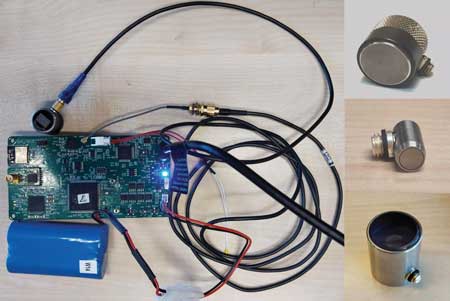 Offshore wind structures operate in highly aggressive environments where salt, moisture and changing weather conditions continuously challenge the integrity of steel components. While uniform corrosion can often be tracked through general thickness loss, localised pitting corrosion introduces a more critical form of degradation due to its confined geometry and strong local effect on material behaviour. Small cavities may develop in isolated areas and remain unnoticed until significant damage has occurred, making early detection difficult, particularly when inspections are separated by months or years. This article describes a practical monitoring approach based on pulse-echo ultrasound, in which a permanently attached sensor repeatedly measures changes in the structural response of a steel component over time. This research has been conducted by Ceit, a technology centre in the Basque Country, as part of the WILLOW project (Wholistic and Integrated digital tools for extended Lifetime and profitability of Offshore Wind farms) funded by the European Union. Laboratory experiments and long-term exposure trials were used to evaluate the capability of this approach to identify changes associated with localised corrosion and to support lifetime assessment through quantitative tracking of pit evolution.
By Marina Perez Diego, Ainhoa Cortés and Andoni Irizar, Centro Tecnológico Ceit, Spain
Attention is placed on how localised corrosion influences ultrasonic wave propagation in steel and how these signal variations can be interpreted for monitoring purposes. The following sections outline the experimental approach, numerical modelling, and long-term observations used to assess detectability under different conditions.
- Details
- Category: Articles
Protecting Offshore Wind Structures for Longer Service Lives
Offshore wind towers and foundations operate in one of the most demanding corrosion environments in the energy sector. 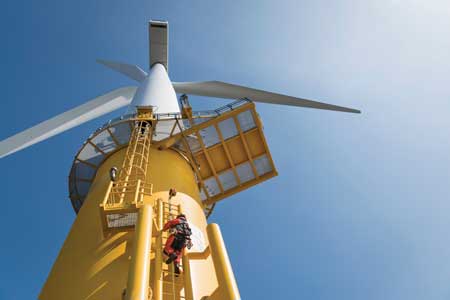 Larger turbines, installed further offshore and exposed to higher mechanical loads, place increasing demands on protective coating systems that must maintain performance for service lives of 30 years or more. While many current coating specifications are based on experience from offshore oil and gas structures, wind turbines experience different challenges, including continuous vibration, cyclic loading, and limited access for inspection and repair. Reducing maintenance requirements is becoming an important factor in lowering life-cycle costs, driving interest in coating systems that offer long-term adhesion, abrasion resistance, and resistance to cathodic disbondment. At the same time, coating development is moving beyond traditional qualification criteria towards performance-based testing methods that better reflect offshore wind conditions. Advances in epoxy technologies, application processes, and testing approaches are helping to improve durability while supporting lower-emission and more sustainable construction practices.
By Eric King, Global Segment Manager, Power and Mining, Protective and Marine Coatings, PPG, USA
To reduce the levelised cost of electricity for offshore wind, developers are focused on extending service life with coatings that provide corrosion protection with minimal maintenance requirements. Effective corrosion protection systems are a key part of lowering operational expenditure and managing life-cycle impacts of wind towers.
- Details
- Category: Articles
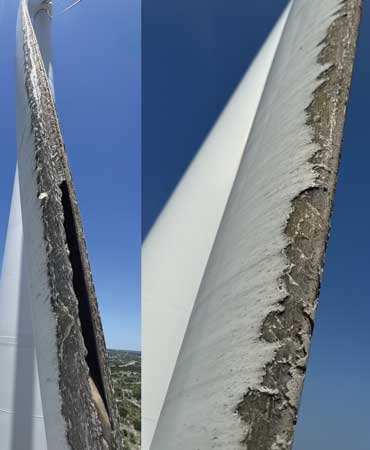 Years of Blade Erosion but a Cure Remains Elusive
In our over 50 years of combined wind energy work, we have watched leading-edge erosion go from a curiosity to a crisis nobody has fully solved. This is not a product review. It is a field record, written from the blade up. From our first eroded blade, at Altamont Pass in 1999, through years of repair work, to spinning test blades at 96m/s (215mph) to put leading-edge protection products through their paces, the story keeps circling back to one fact: nothing has reliably fixed the problem yet. Modern turbines – with longer blades and higher tip speeds – are eroding faster than older fleets ever did, and even the newest coatings are leaving something to be desired. A few years ago, we decided to find out more for ourselves.
By Jack Wallace and Myron Miller, RPE Services LLC, USA
Jack Wallace (co-author) began in wind energy in 1985, working across nearly every discipline, from turbine O&M to blade work. He did not encounter leading-edge erosion until 14 years later, and it stopped him in his tracks. Myron Miller (co-author) later joined, bringing testing and materials expertise.
- Details
- Category: Articles
Why Multi-Height Wind Forecasts Matter for Next-Generation Offshore Turbines
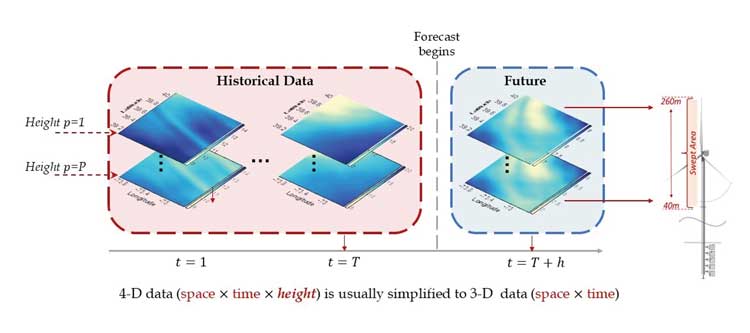
The offshore wind industry is moving towards larger and taller turbines. Modern offshore wind turbines can now have rotor diameters exceeding 200 metres. While larger turbines can capture more energy and improve offshore wind economics, they also challenge one of the simplifying assumptions that has guided operational wind energy forecasting for decades: that a single wind speed at hub height represents the wind energy resource available to a wind turbine. To address this emerging challenge, researchers from Rutgers University have developed a new forecasting method that harnesses advancements in artificial intelligence to produce forecasts of the full vertical wind profile swept by large offshore wind turbines.
By Ahmed Aziz Ezzat, Associate Professor of Industrial & Systems Engineering, Rutgers University, USA
- Details
- Category: Articles
New Material and Design Concepts Supporting Circularity in Wind Turbine Blades
Wind energy plays a key role in the transition towards renewable and low-carbon energy systems. As global wind capacity continues to grow, increasing attention is being paid to the lifetime, repairability and end-of-life treatment of rotor blades, which are mainly made from composites reinforced with glass fibre and, in some cases, carbon fibre materials. Improving the circularity of these structures has therefore become an important challenge for the wind industry. Within the European research project ReCreate, the project partners INVENT, RES-T, Applus+ Rescoll, and the Fraunhofer Institutes WKI and IWU are developing new approaches, combining alternative materials, manufacturing technologies, and design strategies to enable more repairable and recyclable rotor blade structures.
By Justus von Freeden, Research Associate, Fraunhofer IWU, Germany