



 Türkiye has developed one of the most active wind energy markets in the Mediterranean region, combining strong onshore resources with a growing manufacturing base and a broad project pipeline. Wind power now plays a central role in the country’s strategy to strengthen security of supply, reduce import dependency, and reach net-zero emissions by 2053.
By Ibrahim Erden, President of the Turkish Wind Energy Association (TÜREB)
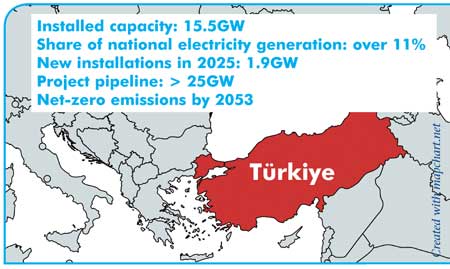
Electricity demand in Türkiye continues to rise in line with population growth and industrial activity. Within this context, wind energy has shifted from a marginal technology to a core component of the national power mix. By the end of 2025, installed wind capacity had reached almost 15.5GW, contributing more than 11% of national electricity generation.
From Early Projects to Large-Scale Deployment
Although traditional wind turbines have long existed along the Aegean coast, modern wind development began in 1999 with the installation of the first commercial turbine. During the 2000s, early projects established the foundations for expansion. By 2010, installed capacity had reached around 1.3GW. Over the following decade and a half, capacity increased more than 10-fold.
Policy and regulatory measures have supported this growth. The Renewable Energy Law, introduced in 2005 and subsequently strengthened, created a stable investment framework. Auction-based support schemes, improvements in grid planning, and the evolution of electricity market mechanisms further encouraged deployment. As a result, the market has attracted domestic developers as well as European utilities, infrastructure funds, and Asian strategic investors.
Industrial Capacity and Export Activity
A defining feature of Türkiye’s wind sector is its industrial depth. The country has developed a manufacturing ecosystem covering towers, blades, generators and numerous subcomponents. Production serves both the domestic market and export destinations.
Annual wind-related exports have reached approximately € 2.2 billion. The sector supports around 25,000 jobs across manufacturing, construction, engineering, and operations and maintenance. This industrial base shortens supply chains, enhances energy security, and integrates Türkiye into global wind value chains.
Pipeline Growth and System Integration
In 2024, Türkiye installed 1.3GW of new onshore wind capacity, followed by 1.9GW in 2025. This performance placed the country among Europe’s leading markets for annual additions in 2025. A project pipeline exceeding 25GW has already been allocated to developers, providing long-term visibility.
An important feature of recent policy has been the allocation of mandatory storage-integrated renewable licences in 2023 and 2024, including 18.5GW of wind and 13.5GW of solar. Storage integration is expected to support system stability and facilitate higher shares of variable generation.
Grid capacity remains a key constraint as renewable deployment accelerates across technologies. Investment in alternating current transmission infrastructure is ongoing, while high-voltage direct current transmission projects are in the planning stage. Further alignment between generation expansion and grid development will be required to sustain growth. Permitting procedures have improved in recent years, although continued streamlining may be necessary.
Offshore Prospects and Long-Term Outlook
Türkiye’s economically viable onshore wind potential is estimated to be more than 120GW. Total technical potential, including offshore resources, may reach up to 200GW with current technologies. Offshore wind is at an early stage, with feasibility studies and regulatory preparations underway. Interest from international developers is increasing.
Additional growth areas include repowering of ageing wind farms, hybrid wind–solar projects, and licence-exempt industrial installations supported by corporate power purchase agreements. These models broaden financing options and allow industrial consumers to secure long-term renewable electricity supply.
Wind energy remains central to Türkiye’s strategy to reduce coal use, strengthen energy independence, and meet climate objectives. Further integration with storage, digitalisation, and flexible market design is expected to improve system resilience as renewable penetration increases.
Through engagement with international industry organisations, including the Turkish Wind Energy Association and the World Wind Energy Association, stakeholders contribute to global policy dialogue and knowledge exchange. Türkiye’s wind sector illustrates how resource potential, regulatory development, and industrial capability can combine to support sustained renewable energy expansion.
Windtech Markets is a collaboration between Windtech International and the World Wind Energy Association and is based on the WWEA Podcast.
Map created with mapchart.net