





Data Availability Impacts Uncertainty of Long-Term Corrected Wind Surprisingly Little
According to common guidelines for the evaluation of site-specific wind conditions, a measurement campaign should have at least 90% data availability during a consecutive 12-month period in order to be complete. However, obtaining this high data availability with a Doppler lidar can be a challenge in locations with small amounts of atmospheric aerosols, for example in the Nordic countries or mountainous regions. Regardless of the lower data availability, the data measured in these locations can still hold valuable information that can be used to reduce uncertainties in a wind resource assessment. Therefore, we suggest that instead of discarding data with less than 90% data availability, the uncertainties due to the lower lidar data availability should be quantified and considered in the wind resource assessment. This is in line with the upcoming IEC framework for the assessment and reporting of the wind resource and energy yield.
By Pyry Pentikäinen, Adviser, Kjeller Vindteknikk, Finland
In wind resource assessment, the largest uncertainty arising from low measurement data availability is related to the long-term correction of the wind speed. Hence, a methodology for assessing this uncertainty was developed by creating simulated time-series that mimic the data availabilities of real lidar measurement campaigns.
Long-Term Correction of Wind Speed
As measurement campaigns for wind resource assessments generally last between one and four years, the measured wind speeds must be long-term corrected to reduce possible errors in the estimated long-term wind resource arising from the natural variability of the wind speed. The uncertainty of the long-term correction depends on the length of the measurement period and the data availability, with a longer measurement period and higher data availability resulting in a smaller uncertainty. A commonly used threshold for sufficient data availability during a consecutive 12-month period is 90%. However, using a simple threshold to determine whether a dataset can be used for wind resource assessment seems arbitrary and likely results in rejection of a lot of valuable data. Therefore, it is important to quantify the long-term correction uncertainties for datasets with availabilities less than 90% so that this data can be used in wind resource assessment.
Variation of Lidar Data Availability with Meteorological Conditions
The availability of lidars is heavily dependent on the atmospheric aerosol concentration, with the instrument not being able to measure wind under too low concentrations. Additionally, fog and strong precipitation can reduce the lidar data availability even further. While the data availability of lidars is not directly dependent on the wind speed, the conditions which result in low data availability may be. For example, in the Nordic countries, low aerosol concentrations are more typical during stable atmospheric conditions, which are generally associated with low wind speeds. Therefore, the missing lidar data may be distributed disproportionately in time to periods with low wind speeds. This indirect wind speed dependency may increase the uncertainty associated with low data availability.
Assessment of Long-Term Correction Uncertainty
In order to calculate the long-term corrected wind speed, two datasets are required: the short-term measurement data and the long-term reference data. The reference data is generally obtained from reanalysis weather models. However, for quantification of the long-term correction uncertainty, more data is required. Measurement data matching the long-term reference data is needed for calculation of the true value of the long-term wind. Additionally, short-term data with both high and low data availabilities is needed in order to assess the increase in the uncertainty due to data availability < 90%. As having all of these datasets from the same location is extremely rare, the low data availability lidar data had to be simulated. The simulated data was based on high data availability anemometer data with added artificial gaps.
Addition of Artificial Gaps from Real Lidar Data Measurements
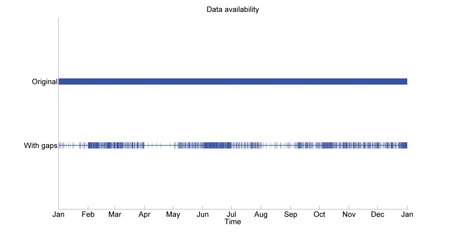
Artificial data gaps were obtained from lidar measurements from two one-year measurement campaigns with collocated met-mast and lidar data. Both measurement locations were in the Nordics in remote locations within low aerosol conditions, thus presenting worst case scenarios for low data availability due to environmental conditions. Data availabilities from seven different measurement heights between 100 and 300 metres above ground level were analysed from both locations, resulting in 14 different types of availability gaps. The artificial availability gaps included the seasonal and wind speed influence on the data availability. These gaps can then be applied to any good data availability wind speed time-series to reproduce data gaps similar to those from the two lidar campaigns. One example of the resulting data availability is visualised in Figure 1.
Estimation of Uncertainty of Long-Term Correction
Finally, long-term corrected wind speeds were calculated for 282 one-year time-series, each of which had > 90% data availability. These time-series were from 29 different measurement locations across the Nordics (Figure 2). The total measurement period at each location was 6 to 20 years. The average wind speed over the entire measurement period was treated as the true long-term wind speed with which the long-term corrections were compared. Fourteen different types of artificial lidar data availabilities were applied to each of the one-year time-series to evaluate the impact of the reduced data availability on the long-term correction uncertainty. To ensure that the uncertainty estimates are on the conservative side, the final considered uncertainty is defined as the sum of the standard deviation and the mean error of the prediction errors. The long-term correction was performed using two alternative methods.
Influence of Data Availability on Long-Term Correction Uncertainty
The resulting uncertainties presented in Figure 3 show, expectedly, that generally the uncertainty increases with decreasing data availability. However, the increase is smaller than expected, being < 0.5% even with data availabilities of less than 30%. Data availabilities that are this low are rare; hence, in most realistic cases the increase in the long-term correction uncertainty is smaller. For lidar data availabilities > 70%, the largest increase in uncertainty is approximately 0.25%. There is notable variation between different long-term correction methods, different reference datasets, and which of the two lidar campaigns the artificial data availability derived from. This indicates the need for this type of uncertainty evaluation to be performed for the exact combination of long-term correction method and reference dataset used in the wind resource assessment.
Conclusions
The increase in uncertainty in the long-term corrected wind speed with low lidar data availability is surprisingly small. While there is some impact on the total wind speed uncertainty, data with 70% availability is still highly usable, and even a significantly lower data availability can reduce the total wind speed uncertainty if it allows larger reduction of horizontal or vertical extrapolation uncertainty. The benefits of using lidar data with low availability have to be evaluated on a case-by-case basis, but generally the data can be used for long-term correction as long as the associated uncertainties are known and well documented.
Biography
Pyry Pentikäinen has been working as an adviser at Kjeller Vindteknikk for two years with a focus on wind resource assessment and analysis of wind measurement data. He has eight years of experience in academic research with Doppler lidars and is finalising his PhD thesis on the subject.