



The Effect on the Bottom Line
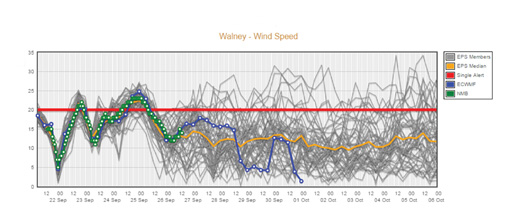 One of the most difficult jobs facing project managers tasked with the mobilisation of critical resources in the renewables industry is planning ahead for what are often referred to as medium range weather impacted events. Forecasting weather over longer periods (typically up to 15 days in advance, often termed medium range forecasts) is extremely difficult to predict with any degree of accuracy due to the volatile and chaotic nature of the atmosphere. Very small variations in the initial conditions of a computer forecast model can lead to huge variations in the forecast – a phenomenon known as the ‘Butterfly Effect’. This is why forecasters can typically only forecast conditions up to roughly three days ahead with any degree of precision. Beyond this timescale, conditions become significantly more influenced by these tiny initial variations.
By Polly Kirk, Regional Marketing Executive, MeteoGroup, UK
Understanding Uncertainty
The key to understanding medium range weather forecasting lies in knowledge of how to deal with uncertainty. Weather is a risk-related activity because forecasters are dealing with uncertainty. One of the best ways of addressing this, whether it be related to weather prediction or any other risk assessment activity, is to use probability as the mechanism of measurement.