




A Few Potential Design Alternatives and System-level Reassessment
 In recent years, increasing evidence of failures has been reported from spherical roller main bearings used in three-point mounting (TPM) drivetrains of wind turbines. One of the leading causes has been micropitting, a failure mode that is possibly overlooked by design, selection and life-prediction tools. It remains to be seen if retrofitting problematic spherical roller bearings (SRBs) with improved bearing design solutions can improve their durability. Questions to ask might be: ‘Are the operating conditions of the main bearing well understood?’ and ‘Are the failures caused by deficient design practice or other unidentified external sources within the system?’ These questions fundamentally challenge the underlying design basis and encourage the need for a system analysis approach that is currently being undertaken by researchers from the National Renewable Energy Laboratory (NREL). Specifically, this article discusses a few potential design alternatives and system-level reassessment to circumvent micropitting in main bearings used in TPM drivetrains.
By Latha Sethuraman, Yi Guo and Shuangwen Sheng, National Wind Technology Center, National Renewable Energy Laboratory, USA
Conditions Leading to Micropitting
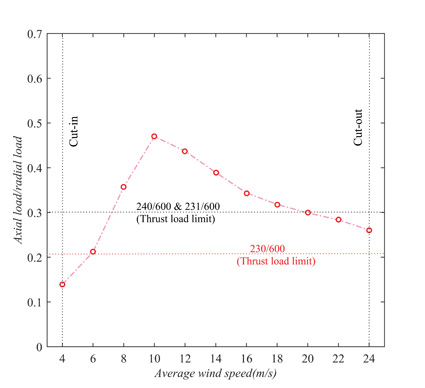
Most common main shaft arrangements for TPM drivetrains in wind turbines rated 1.5–2MW employ SRBs. These bearings exhibit a high tolerance to system deflection and misalignment but limited tolerance to thrust loads (in most bearing designs the axial loads cannot exceed 10‒38% of their two-row radial reaction). Preliminary studies by the authors [ref. 1] were carried out using a system analysis approach for a representative TPM wind turbine with a 230/600 series SRB (having a design axial load limit that is 22% of the radial loads). Modelling results (see Figure 1) showed that this design limit is exceeded for a majority of the turbine’s operating conditions.