



 A Revolutionary Idea for Energy Storage
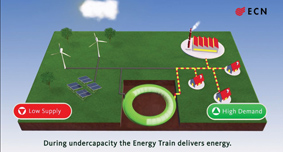
In order to address the problem of global climate change, a number of measures are needed. Apart from saving energy, electricity increasingly needs to be produced using renewable sources. The European Commission’s energy road map for 2050 states that 55% of the total amount of electricity produced in 2050 should come from renewable sources. The Dutch government has an even more ambitious goal (national energy agreement) and wants to have a climate-neutral energy supply by 2050. In order to reach these targets, a lot of renewable energy sources, such as solar and wind, must be installed in the next few years and this will lead to an increasing proportion of intermittent power. This will mean that imbalances between the supply and demand for electricity are likely to become more common.
By Wouter Engels, ECN, The Netherlands
Energy Storage
In an energy system with large amounts of renewable energy like wind power and solar power,energy storage is a key requirement to ensure a constant and safe energy supply in the future. Energy storage itself is not a new idea. Pumped hydro has already been used for years and currently accounts for around 95% of all installed storage facilities. However, this technique comes with some disadvantages. In particular, it requires certain topographical conditions (i.e. mountains) that may not be readily available everywhere where you might want to store energy. The Netherlands, for instance, does not have mountainous regions where this would be feasible. Other techniques that are currently in use include compressed air, thermal storage, batteries and flywheels. Each of these techniques has its advantages and disadvantages.