



 Use of Lidars to Quantify Flow and Wind Turbine Wakes
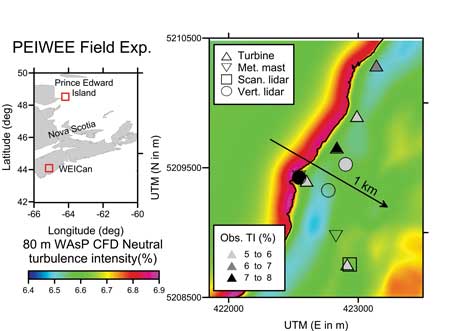
Wind turbine nameplate capacities (and physical dimensions) are increasing and turbines are being deployed in increasingly complex/harsh environments. Hence, shortcomings are becoming evident in our understanding of the flow parameters of relevance to wind resources and turbine loading in inhomogeneous settings. Furthermore, propagation and dissipation of wakes from turbines on ridges and/or on escarpments and/or when flow interacts with vegetation are incompletely understood. While model predictions of the mean and time-evolving components of flow may be imperfect in simple topography, model errors tend to be relatively small. However, systematic and non-trivial model biases can exist in complex terrain. Hence there is a need for full-scale experiments using remote sensing technologies (notably lidars) to quantify key flow characteristics and provide data that can be used in model development and evaluation. Here we describe some key research opportunities and challenges facing these experimental investigations and present results from our recent field campaigns.
By Rebecca J. Barthelmie and Sara C. Pryor, Cornell University, USA
Introduction of new measurement technologies (including lidar) requires careful performance assessment (accuracy, reliability and precision), robust uncertainty quantification and development of normative guidance (e.g. IEC 61400-12-1 protocols). It further requires development of expertise in the operation of lidar and analysis and processing of the resulting data. Some kinds of lidar are already in standard use, but use of remote sensing technologies to provide high-quality observations of relevant flow parameters in inhomogeneous terrain and/or complex forested terrain is not straightforward. Moving forward it is likely that integrated measurements from multiple different types of instruments including lidar will be needed to provide the quality and detail required to accurately predict power and loads on wind turbines in these more challenging environments.