A Company Geared for Success
The German firm of Gebr. Eickhoff GmbH has been family-owned for five generations and since 1864, has had its headquarters in Bochum near Dortmund. It also has other subsidiaries worldwide. The firm specialises in producing foundry, mining machinery, and industrial and wind turbine gearboxes. In this article Eize de Vries finds out more about the history, capabilities and aims of the company.
By Eize de Vries, Journalist & Consultant Wind Energy, The Netherlands
The front of the main office building of Gebr. Eickhoff GmbH, now nearly 150 years old, effectively hides a substantial industrial area lying behind it. The company’s long history of industrial development started off with a foundry and a mining machinery parts business (Box 1).
In-house production of industrial gearboxes for Eickhoff’s mining equipment started in the 1950s at this location in Bochum, followed by the manufacturing of in-house developed industrial gearboxes for third-party clients two decades later. Today Eickhoff employs around 1,800 staff worldwide, including 300 employees spread over eight subsidiaries in Europe, Asia, South Africa, Australia, and a Pittsburgh-based wind turbine gearbox repair facility in the USA (Box 2).
The first batch of series produced gearboxes for wind turbines left the company’s main facilities in Bochum in 1990. So far the highest rated Eickhoff wind turbine gearboxes have been for eight pioneering 3.6MW GE turbines, a 2002 prototype, and seven additional units operating at the British Arklow Bank wind farm since 2003/04.
Dedicated Facilities for Wind Turbine Gearboxes
In early 2009, Eickhoff Wind Power, a separate business unit of the Eickhoff Power Transmission division, inaugurated a new facility at Klipphausen near Dresden dedicated solely to the serial production of wind turbine gearboxes. Currently Eickhoff’s cumulative wind turbine gearbox manufacturing capacity amounts to 3,000MW per annum, subdivided in a 50/50 share for each of the two facilities. However, this capacity is not being fully utilised at the moment because of the difficult market conditions. The company’s global market share for wind turbine gearboxes amounted to 4.1% in both 2011 and 2012, and the global installed base is around 10GW.
For a long time Eickhoff’s volume class product portfolio has included conventional high-speed three-stage gearboxes for turbines in the 1.5–2.5MW power rating ranges, but recently there has been an upward trend for units of up to 3.8MW. The company’s design and manufacturing capabilities now extend into the 6–7MW offshore ‘super class’.
Gearboxes rated up to 2MW typically comprise one planetary and two helical, parallel shaft gear stages (PSS-design). Above 2MW, but depending upon rotor diameter, this switches to two planetary and one helical stage called PPS-design. This capacity-related gearbox design step-change represents a technical optimising issue because, while planetary gear stages combine compactness with a capability to transmit high torque loads, they are also more complex when compared to helical stages.
Long-Term Focus on Design and Quality
The company’s long-term focus on integrated product design and quality was explained by the product manager for wind turbine gearboxes, Thomas Nahrath, in his introduction to a tour of the Bochum facilities. He added: ‘Furthermore of key importance to us are synergy effects between divisions, and setting out and maintaining clear technology and business development strategies. We also conduct gearbox repairs and offer complete reconditioning services. This service package expands into technology upgrades like, for instance, a High Load Upgrade (HLU) for the Eickhoff gearbox used in GE’s 1.5S turbine model. If applicable such upgrade support can also be offered for external competitor gearboxes.’
This capability in turn is enabled by Eickhoff’s comprehensive in-house engineering know-how reinforced by a modern materials analysis laboratory. The same lab is used for analysing the raw materials inflow.
Raw materials for gears and shafts are brought in from external suppliers, shaped as solid steel bars, large rings or otherwise. These materials are further processed into final components through various machining operations and advancing process stages. The actual gear cutting is an almost fully automated high-precision activity. All specialist gear suppliers, including Eickhoff for this specific task, apply a blend of semi-standard gear profiles and specific but strictly in-house know-how. Their key focus is on ensuring optimised load transfer and lubrication performance, quieter running and enhanced lifetime. Nahrath said: ‘Our gearboxes are the quietest in the market. This is the combined result of decade-long in-house engineering experience, our comprehensive gear and gearbox R&D capabilities, an integrated design approach, and a continuous main focus at manufacturing quality and product excellence. A good example to illustrate this point is our gear teeth surface treatment, called vibratory finishing. This is a final gear manufacturing process step offering smoother running, while simultaneously improving lubrication performance and elongating operating lifetime.’
Inside a prototype assembly and testing hall Nahrath pointed at a helical gear with very smooth almost shining gear teeth surfaces in different colours. He explained that this deliberate colour pattern is for test runs and helps provide better insight into gear contact area meshing and surface contact patterns.
More Testing and Development
Another helical gear in the prototype hall had multiple strain gauges fitted at equally spaced distances all along a gear tooth’s base area. This specific test set-up is aimed at determining loads and load distribution during rotation when meshing teeth continuously engage and disengage.
In a separate prototype arrangement strain gauges were attached to a huge 3MW-size cast planet wheel carrier for measuring stiffness characteristics under load. These measurements are then evaluated in relation to product-design simulation results.
Nahrath explained: ‘Gearbox design is an integrated process always conducted in close cooperation between a turbine OEM and the gearbox supplier. OEMs usually deliver the main specifications and a conceptual design, which our engineer teams then develop further into a final product. It thereby sometimes happens, for instance, that gearbox development process advancement pinpoints a need for main chassis design modification.’
This example underlines the great value Eickhoff attaches to the regular exchange of ideas, and the need for a continuous evaluation of the progress being made, in order to achieve technically and economically optimised final products. Nahrath also noted that increasingly this approach to turbine and gearbox development is starting to match industrial automotive design practice.
For gearbox testing, the Bochum facilities comprise one large 5MW test bench, in which operating temperatures down to –40°C can be simulated. There are smaller additional gearbox test benches of 3MW and 4MW each. A fourth test bench of 4MW is located in Klipphausen. All four units enable 'highly accelerated life testing' (HALT), a standardised method whereby gearbox overloading is routinely introduced and which compresses a full, usually 20-year, design life into a period of only a few months.
Eickhoff’s two main gearbox customers (megawatt base) are Nordex and REpower, both of Germany. Other clients include GE, and German project developer and turbine manufacturer e.n.o.
For several years Eickhoff has supplied REpower with 3.4MW and more recently 3.2MW class high-speed gearboxes for the 3XM-series. Other 3.0MW and 3.3MW gearboxes will be supplied for the new Nordex Delta series, and again other 3MW+ gearboxes to e.n.o.
As Nahrath concluded, ‘At the moment we investigate a number of potential future technology solutions, including a compact semi-integrated medium-speed drive-train comprising gearbox, generator and converter. However, such ambitious development will be tackled in close cooperation with a generator specialist.’
Foundry and Mining Equipment
Eickhoff operates one of Germany’s largest specialised foundries today, currently running at an annual production capacity of 13,000 metric tonnes but planned for increase to 20,000mT within the next few years. The foundry operates on a three-shift 24/7 schedule during busy periods. A wide range of cast iron and cast steel products are for both internal use like Eickhoff turbine gearbox components and external third-party usage. The biggest castings produced weigh up to 18 tonnes. About 10% of annual output on a mass basis comprises grey cast iron, 15% cast steel, and the remaining 75% spherical cast iron also known as ‘nodular’ or ‘ductile’ cast iron.
Grey cast iron is, among other things, used for wind turbine gearbox housings, hatches and covers. Spherical cast iron contains tiny amounts of magnesium added during the liquid process that allows the carbon to concentrate in spheroidal particles as the material solidifies. This carbon concentration, shape and distribution provides superior mechanical properties compared to grey cast iron that make it well suited for highly stressed heavy-duty applications such as gearbox planet carriers and torque side supports.
Since the 1980s Eickhoff has also become a respected global mining industry leader with a range of high-tech shearer loaders for underground coal mining. The huge bright yellow-coated machinery is both internally and externally characterised by a high, and still increasing, degree of product control and automation. Early twentieth century reconditioned loaders on display by the side of the latest machinery in the factory represent an impressive timeline highlighting engineering pride and competence, continuous technological progress and industrial product advancement. |
|
Eickhoff Corporation, Pittsburgh (USA)
Back in 1982 Eickhoff Power Transmission (EB) established Eickhoff Corporation (EC) in Pittsburgh (USA) as a specialised service and repair business for mining equipment and industrial systems and components. Today EC still refurbishes mining equipment in Pittsburgh, while from 2009 the refurbishment of wind turbine gearboxes, including workshop and up-tower repairs, has also become an integral part of the service activities package.
The business was from the very beginning focused on future growth in parallel with increasing customer demands. As Nahrath explains: ‘If, for example, the market share of a specific turbine supplier using Eickhoff gearboxes increases, EC’s service offering to this OEM could keep pace as well. Each Eickhoff-made gearbox can further be refurbished at EC’s facilities, while up-tower services and inspections of all our gearboxes are standard options too.’
Specific service offerings include up-tower inspections involving visual outer checks, internal checks of otherwise inaccessible planetary and helical stages with the aid of an optical instrument called a borescope, and vibration testing. All are preventive measures aimed at detecting potential future failures at an early stage and before irreversible damage develops.
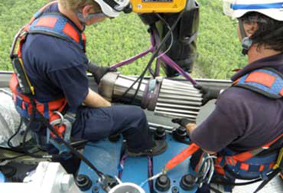
A second service category offers the possibility of gearbox up-tower repairs as a cost-effective alternative to gearbox exchange, which requires the aid of an expensive crane. Depending upon turbine and gearbox make and model EC is able to offer a range of specialist services. These include, among others, high-speed shaft (HSS) exchange, bearings exchange of the HSS, intermediate-speed shaft (IMS) and low-speed shaft (LS) gear stages, and central cable tube exchange.
End-user customers such as utilities, wind farm operators and independent service providers could all be provided with a semi-standard service package valid for original Eickhoff gearboxes. Furthermore, EC has a list of third-party gearboxes that it has already reconditioned and/or upgraded via a sophisticated reverse-engineering process that it has been able to carry out because of its own gear and gearbox know-how and experience. Nahrath: ‘Because these refurbished third-party gearboxes fully meet our technical and quality product standards, they fully qualify for our service and repair support service as well. EC and EB further enable OEMs and other selected clients to benefit from our spare parts inventory and exchange gearboxes storage service. Some customers thereby seem to specifically appreciate EC's optional storage offering for complete gearboxes with the main shaft and rotor bearing assembly already attached.’
|